
The appliance energy label explained: reading, comparing, calculating
Since 2021, the European energy label has changed: goodbye A+++, hello a much stricter A-to-G scale. As a result, a very good fridge can show a C. Here's how to read the label family by family, how to convert kWh into euros at Belgian prices, and how to check a model in the EPREL database.
- A to G since 2021: a current C is equivalent to an old A+++
- Cooling in kWh per year, washing in kWh per 100 cycles
- Ovens and hoods: still the old scale A+++ to D
- Annual cost = kWh × about €0.35 in Belgium
Why the label changed
The old label had filled up from the top: almost all appliances showed A+, A++ or A+++, and the difference was no longer visible. The European Union therefore reset the scale with a A-to-G scale, deliberately demanding: at launch, class A was almost empty, leaving room for progress in the years ahead.
The practical consequence is simple: never compare a letter from the old scale with a letter from the new one. A class C washing machine or a class D fridge today are good appliances. And the progress is real: according to the European Commission, an average fridge-freezer sold consumed 477 kWh a year in 1990, 181 kWh in 2020, and should fall to around 114 kWh by 2030.
Which scale for which appliance in 2026?
| Family | Scale | Since | What is measured |
|---|---|---|---|
| Fridges, freezers, wine coolers | A to G | 1 March 2021 | kWh per year |
| Washing machine | A to G | 1 March 2021 | Eco 40-60 programme, kWh per 100 cycles |
| Washer dryer | A to G (two classes) | 1 March 2021 | Washing only, and washing + drying |
| Dishwasher | A to G | 1 March 2021 | Eco programme, kWh per 100 cycles |
| Tumble dryer | A to G | 1 July 2025 | Eco programme, kWh per 100 cycles |
| Ovens | A+++ to D (old) | 2015 | kWh per cycle |
| Cooker hoods | A+++ to D (old) | 2015 | kWh per year |
| Hobs | no label | not applicable | Ecodesign only |
Good to know: since 1 July 2025, EU ecodesign rules only allow the sale of heat-pump tumble dryers heat pump. Older resistance-based condenser models have disappeared from new stock.
Reading a fridge label
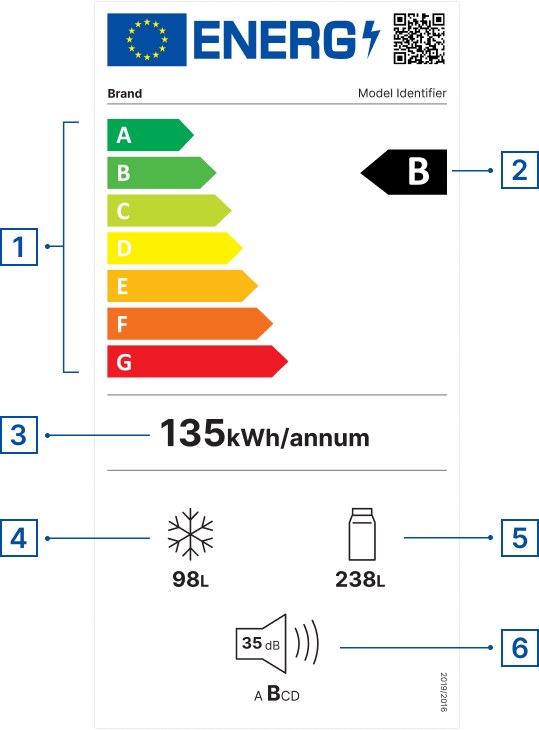
- The scale from A (most efficient) to G.
- The class of the appliance.
- Annual energy consumption in kWh : the figure to use when calculating the cost.
- Freezer volume in litres (absent if the appliance has no freezer section).
- Fridge volume in litres.
- Noise in dB(A), with a class from A (quietest) to D.
The QR code at the top right opens the model's record in the EPREL database. The full record also gives the climate class (the room temperature in which the appliance operates correctly), essential if you're considering a garage. Our advice on this is in the fridge buying guide.
Reading a washing machine label (and a dishwasher label)
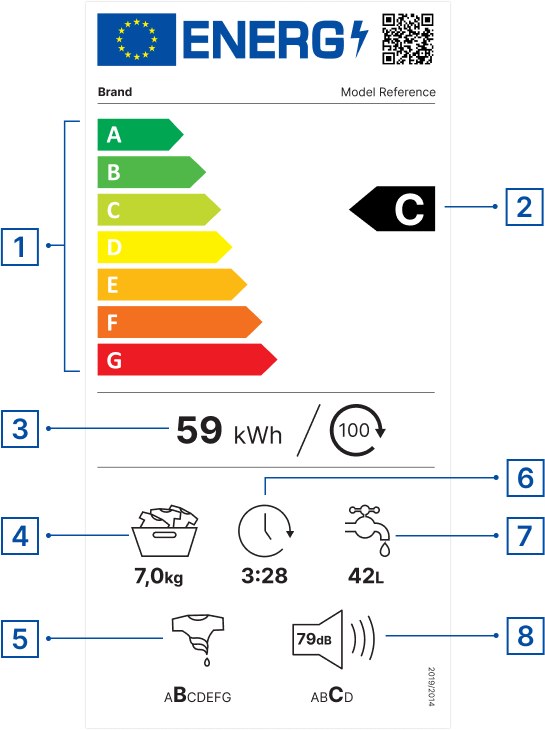
- The scale from A to G.
- The class of the appliance.
- Consumption in kWh per 100 cycles of the Eco 40-60 programme.
- Rated capacity in kg.
- The spin efficiency class (A to G): the higher it is, the drier the laundry comes out.
- The duration of the Eco 40-60 programme at full load.
- Water consumption per cycle, in litres.
- Spin noise in dB(A), with its class from A to D.
The Eco programme takes a long time (often more than 3 hours), and that is normal: it heats the water less and makes up for it with time. The dishwasher follows the same logic: class, kWh per 100 Eco cycles, number of place settings, litres per cycle, duration and noise. The tumble dryer adds a condensation efficiency class. A 10 dB difference is perceived as a noise roughly twice as loud. To choose your machine, see the washing machine guide.
Ovens and hoods: still the old label
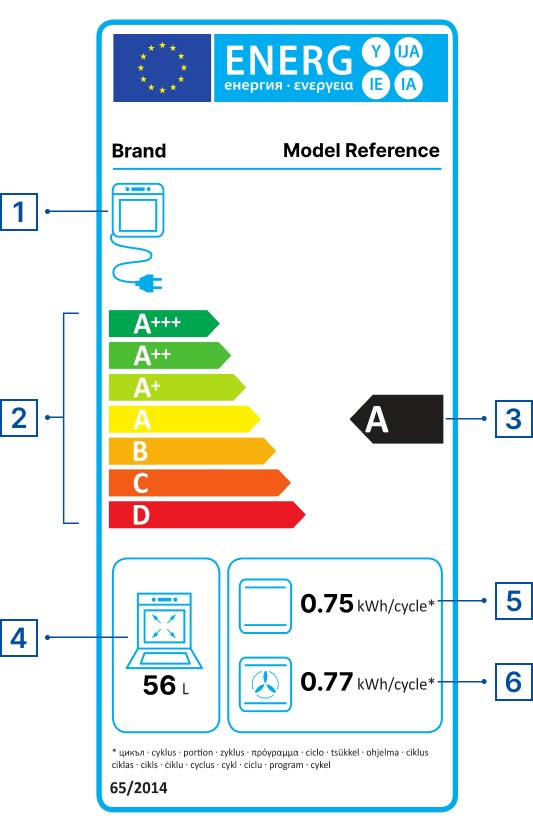
For an oven, you read the energy source (1), the A+++ to D scale (2), the class (3), the cavity volume (4) and the consumption per cycle in conventional heat (5) and fan-assisted heat (6). Most recent ovens are rated A or A+: the difference between two models is small, so choose first on features (see our oven guide). For a cooker hood, the label shows annual consumption and classes for extraction, lighting and grease filtration.
Converting kWh into euros
The calculation is simple:
- Refrigeration : annual cost = kWh per year × price per kWh.
- Washing and dishwashing : annual cost = (kWh per 100 cycles ÷ 100) × number of cycles per year × price per kWh.
What price per kWh? We use €0.35 per kWh including VAT as a ballpark figure. It is consistent with the reference rates published by the CREG for Q4 2026 (around €0.32 in Flanders, €0.37 in Brussels and €0.38 in Wallonia). Your actual price depends on your supplier, your contract, your Region and the capacity tariff in Flanders: for an accurate calculation, use the price per kWh on your bill.
| Appliance (example) | Assumption | kWh per year | Cost per year |
|---|---|---|---|
| 2 m fridge-freezer, class A | label: 110 kWh per year | 110 | ≈ 39 € |
| 2 m fridge-freezer, class D | label: 210 kWh per year | 210 | ≈ 74 € |
| American-style, class E or F | 330 to 420 kWh per year | 330 to 420 | ≈ 115 to 147 € |
| Washing machine 8 kg | 50 kWh / 100 cycles, 200 cycles per year | 100 | ≈ 35 € |
| Dishwasher 13-14 place settings | 75 kWh / 100 cycles, 220 cycles per year | 165 | ≈ 58 € |
| Class A dishwasher | 55 kWh / 100 cycles, 220 cycles per year | 121 | ≈ 42 € |
| Heat pump tumble dryer | 1 to 1.5 kWh per cycle, 150 cycles | 150 to 225 | ≈ €53 to €79 |
| Old resistance tumble dryer | 4 to 5 kWh per cycle, 150 cycles | 600 to 750 | ≈ €210 to €263 |
Ballpark figures calculated at €0.35 per kWh, not precise models. For a given appliance, check its label or EPREL record.
Two lessons: the refrigeration runs 24 hours a day, so that is where the class pays off most over 13 years; and replacing a very old fridge or an old resistance dryer can save more than €100 a year.
The EPREL database: the checking tool
EPREL (European Product Registry for Energy Labelling) is the EU's public database where every manufacturer must register its labelled appliances. To use it:
- Scan the QR code on the label with your mobile, or search for the exact model reference on the European Commission's EPREL website.
- Download the official label and the product information sheet.
- Compare kWh, noise, dimensions, climate class (fridges) or programme duration (washing machines).
It is also the tool our sales staff use to check a figure when a product sheet is incomplete.
Comparing in store: a few examples
| Model | Energy data available | Public price |
|---|---|---|
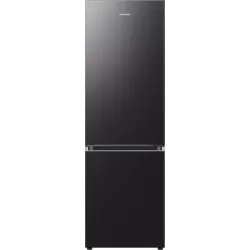
| Samsung RB38C7B6AS9 (fridge-freezer) | Class A according to the Samsung reference | 1 799,99 € |
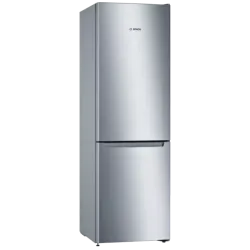
| Samsung RB34C705CB1 (fridge-freezer) | Class C according to the Samsung reference | 899,99 € |
| Bosch KIR81NSE0 (integrated) | Class E, approx. 310 L | 1 079,99 € |
| Haier HSR3918ENPG (American-style) | Class E according to the Haier reference | 1 099,99 € |
| Liebherr CFD2085-26 (chest freezer) | 162 kWh a year, i.e. around €57 a year | 1 099,99 € |
| Samsung NV7B41307AB (oven) | Family rated A+ (old scale) | 679,99 € |
| Bosch DWK87FN60 (cooker hood) | Class A+ (old scale) | 799,99 € |
Public prices checked on nimestore.com on 15 October 2026. The product sheet takes precedence; Nimesclub members often get a reduced price. At Samsung and Haier, a letter in the reference corresponds to the energy class: always check the label.
When choosing between two fridges you like, work out the difference in kWh per year, multiply by 35 cents and by 13 years. If the gap exceeds the price difference, the more efficient one is also the cheaper one. And if it doesn't, pick the one you like best, without feeling guilty.
For TVs, the label works a little differently: see our page on television energy consumption.
A few models to compare in store
 Fridge-freezer SAMSUNG RB38C7B6AS9€1,799.00
 Samsung RB34C705CB1 Fridge-Freezer€742.00
 Combined fridge freezer BOSCH KGN36NLEA€645.00
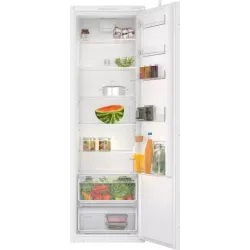 Built-in fridge BOSCH KIR81NSE0€1,079.00
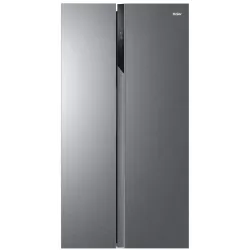 American & Multi-Door Fridge Freezer HAIER HSR3918ENPG€691.00
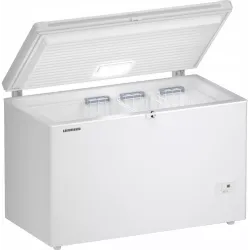 Chest freezer LIEBHERR CFD2085-26€1,099.00
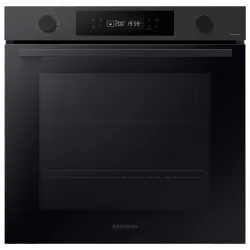 Built-in oven SAMSUNG NV7B41307AB€679.00
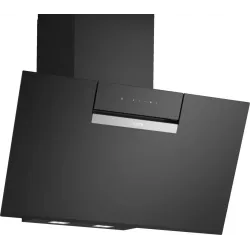 Cooker hood BOSCH DWK87FN60€799.00
Frequently asked questions
Why is my new fridge rated D when my old one was A+?
Because the scale changed on 1 March 2021. The new A to G classes are deliberately strict: a class D fridge-freezer today uses roughly as much as an old A++. Compare kWh per year, not the letters from two different scales.
What does a washing machine's label measure?
The Eco 40-60 programme, in kWh per 100 cycles, along with capacity, water per cycle, programme duration, spin class and noise. A 60 °C cotton wash or a quick programme uses more than what is shown.
Which electricity price should you use for the calculation?
As a rough guide, about €0.35 per kWh including VAT. The CREG reference rates for Q4 2026 are around €0.32 in Flanders and €0.37 to €0.38 in Brussels and Wallonia. Your actual price depends on your contract: check your bill.
What is the QR code on the label for?
It links to the European EPREL database, which gives the full official product sheet: consumption, dimensions, noise, climate class for cooling, and sometimes how long spare parts are available.
Do hobs have a label?
No. Hobs are only subject to ecodesign requirements. When comparing, remember that induction is the most efficient electric cooking technology.
Come and see the appliances in person
At our Temploux shop, we open the doors and compare drums and finishes. Or ask our expert sales adviser online, right now.
Read next
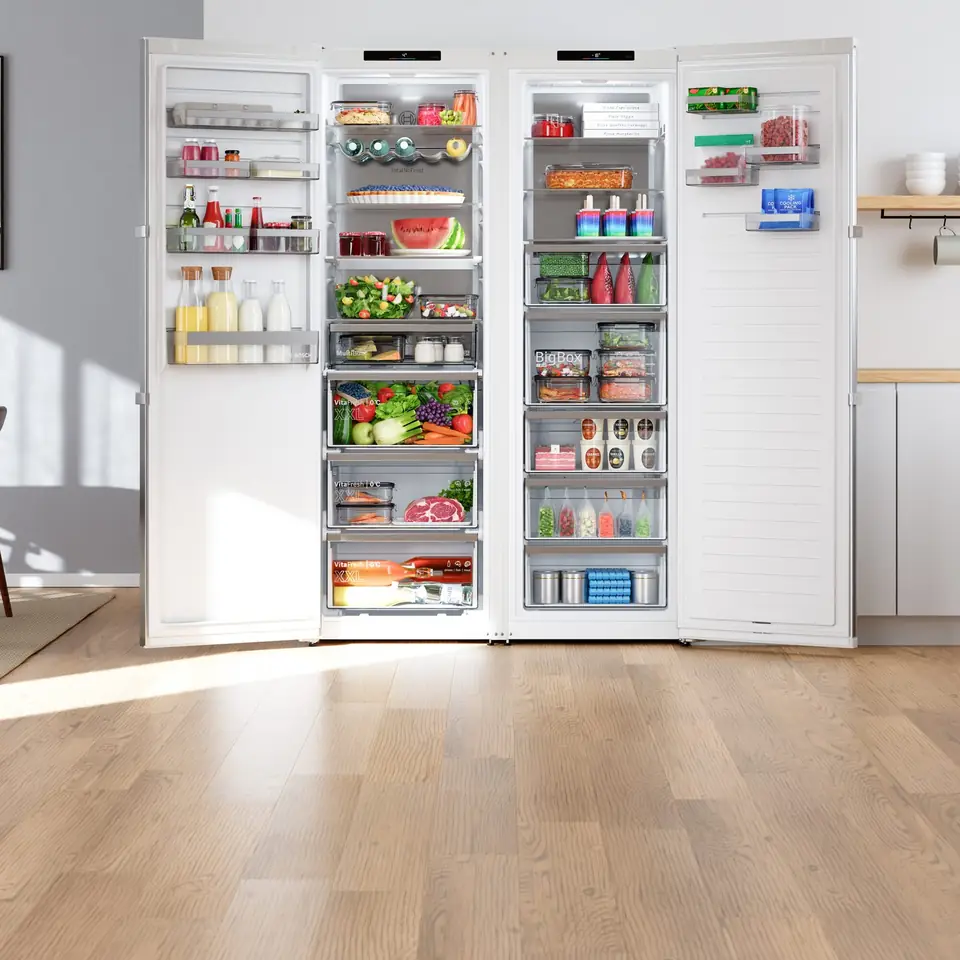 Buying guideChoosing your fridge well in 2026: the complete guideA fridge runs day and night for thirteen years on average, so it's the kitchen appliance that deserves the most care. Format, capacity, fan cooling, crisper drawer, noise, energy label and dimensions: here is everything we check with you in the shop, with real Nimestore models at every budget.8 min read
 Buying guideChoosing your washing machine well in 2026: the complete guideA washing machine runs around two hundred times a year for a dozen years or so, so it's worth choosing it well. Here, criterion by criterion, is what really matters, what is just marketing, and the models we recommend in the shop according to your budget.8 min read
 Buying guideTV energy consumption and energy label: how much does your television cost per year?Class F, class G, 85 kWh/1,000 h: a TV energy label can look daunting, but it's easy to read. We checked the official European database for the energy consumption of twelve 65-inch TVs from 2026 sold in our store, and calculated what they really cost per year.5 min read