
HDR, Dolby Vision, HDR10+: what really changes
HDR is what makes the difference between a 'clean' picture and one that really dazzles. But with all the logos, it's easy to get lost. We sort it out for you.
- HDR delivers more brightness and more nuance, especially if the screen is bright
- Dolby Vision : Netflix, Disney+, Apple TV. HDR10+ : Prime Video
- Samsung doesn't have Dolby Vision, LG and Sony don't have HDR10+
- Dolby Vision 2 arrives in 2026 on Hisense, TCL and Philips
What exactly is HDR?
HDR stands for High Dynamic Range, ‘extended dynamic range'. In plain terms: the image can display areas much brighter and very dark areas at the same time, with more nuance between the two and richer colours.
A sunlight reflection on a car, an explosion in an action film, the light of a candle in a dark room: in HDR, these details stand out as they do in real life, instead of being “crushed” into a uniform white.
HDR formats explained
| Format | How it works | Where to find it |
|---|---|---|
| HDR10 | The basic, universal format. The settings are the same for the whole film (static metadata). | Everywhere: streaming, 4K Blu-ray, consoles |
| HDR10+ | Settings adapt scene by scene (dynamic metadata). Open format, backed by Samsung. | Prime Video, some 4K Blu-rays |
| Dolby Vision | Scene-by-scene adjustment, and even frame by frame, calculated for each screen. | Netflix, Disney+, Apple TV, Canal+, many 4K Blu-rays, Xbox Series X |
| Dolby Vision IQ | Dolby Vision that takes your room's lighting into account thanks to a sensor. | On Dolby Vision TVs fitted with the sensor |
| Dolby Vision 2 | The new generation (2026): better handling of brightness and motion. 'Max' version for high-end screens. | Update rolling out on Hisense, then TCL and Philips |
| HLG | The HDR for live television, without metadata. | Sporting events, YouTube, some channels |
Which brand supports what in 2026?
| Brand | Dolby Vision | HDR10+ | Dolby Vision 2 |
|---|---|---|---|
| LG | Yes | No | Not announced in 2026 |
| Samsung | No | Yes (HDR10+ Advanced on recent models) | No |
| Sony | Yes | No | Not announced in 2026 |
| Philips | Yes | Yes | Announced via update on 2026 OLEDs and the MLED981 |
| TCL | Yes | Yes | Announced via update on C and X series |
| Hisense | Yes | Yes | Rolled out since August 2026 on the UR9S, UR8S and U7S Pro |
Depending on the model: the most affordable models from some brands don't all support every format. Always check the spec sheet of the specific model.
Look at your habits: if you spend your evenings on Netflix or Disney+, go for a Dolby Vision TV. If it's mostly Prime Video, HDR10+ is a plus. And if you watch mostly regular TV, focus on overall picture quality rather than logos.
What really matters for good HDR
- Brightness : this is the fuel of HDR. Mini LED and RGB Mini LED go very high, and high-end 2026 OLEDs do too on small bright areas.
- Contrast : OLED (perfect blacks) or a Mini LED with many dimming zones.
- Picture processing : a good processor handles scenes that exceed the screen's capabilities (known as “tone mapping”). Sony, LG, Samsung and Philips are reputed for this.
- Formats : last. An excellent HDR10 screen will always beat an average Dolby Vision one.
Setting up HDR properly
- Choose the mode Cinema, Filmmaker or Dolby Vision Dark in the evening, the Dolby Vision IQ or Bright Cinema during the day.
- Avoid the “Vivid” or “Dynamic” mode: it forces colours and crushes detail.
- On a console, run the HDR calibration offered by the PS5 or Xbox on first startup.
- For Netflix in 4K HDR, you need a connection of around 15 to 25 Mbps: an Ethernet cable is more stable than Wi-Fi.
Frequently asked questions
Does my Netflix subscription let me watch in Dolby Vision?
Yes, with the plan that gives access to 4K (Premium) and a Dolby Vision-compatible TV. Films and series that support it display the Dolby Vision logo on their page.
Is a TV without Dolby Vision a bad choice?
No. Samsung TVs play these programmes in HDR10, and their high-end screens are excellent. The difference is mostly visible on dimmer screens, which benefit most from scene-by-scene adjustment.
Should I wait for a Dolby Vision 2 TV?
No. Few titles use it for now. If you're torn between two equivalent models, it's a small plus, not a main criterion.
Does HDR work with a regular TV?
Regular channels are still in SDR. HDR is found on streaming platforms, 4K Blu-rays, consoles and a few sporting events (in HLG).
Come and compare the screens in person
At our Temploux shop, we switch on TVs side by side with your content. Or ask our expert salesperson online, right now.
Read next
 TechnologyOLED explained simply (WOLED, QD-OLED, Tandem)Perfect blacks, infinite contrast, a picture that still looks great from the side: OLED is a dream. But how does it work, what's the difference between WOLED and QD-OLED, and what about the famous burn-in: myth or reality? We tell you everything.3 min read
 TechnologyLED, QLED, Mini LED: LCD screens explainedQLED, Neo QLED, QNED, Mini LED, SQD… all these names belong to one family: the LCD screen. What makes the difference is how it's lit. We explain everything so you can read a spec sheet like a salesperson.2 min read
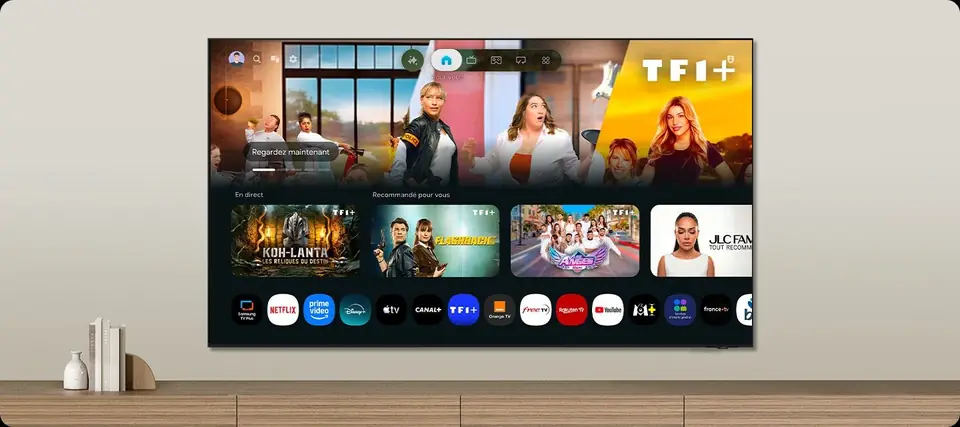 TechnologySmart TVs and Belgian apps: which system for Auvio, VRT MAX, Play or Pickx?The Smart TV system is your television's brain: menus, apps, updates. In Belgium, it also decides whether you can watch Auvio, VRT MAX or your operator's app without a box. Here's our comparison of the six 2026 systems, with a table of Belgian apps checked against the official help pages.7 min read