
OLED explained simply (WOLED, QD-OLED, Tandem)
Perfect blacks, infinite contrast, a picture that still looks great from the side: OLED is a dream. But how does it work, what's the difference between WOLED and QD-OLED, and what about the famous burn-in: myth or reality? We tell you everything.
- Each pixel produces its own light: perfect black, no halo
- WOLED (LG, Philips, Sony Bravia 6) and QD-OLED (Samsung, Sony Bravia 8 II)
- 2026: the panels Tandem become much brighter
- Burn-in: low risk with varied use
How does an OLED screen work?
On an LCD TV (LED, QLED, Mini LED), a backlight placed behind the screen lights up millions of tiny “shutters” that let through more or less light. Even when closed, these shutters let a little light leak through: black is never quite black.
On an OLED (Organic Light-Emitting Diode), there is no backlight: each pixel produces its own light. When it needs to be black, it switches off completely. This is what gives:
- perfect black and infinite contrast;
- no halo around subtitles or stars on a black sky;
- excellent viewing angles : the picture stays accurate, even from the side;
- near-instant responsiveness, ideal for sport and gaming;
- ultra-slim TVs.
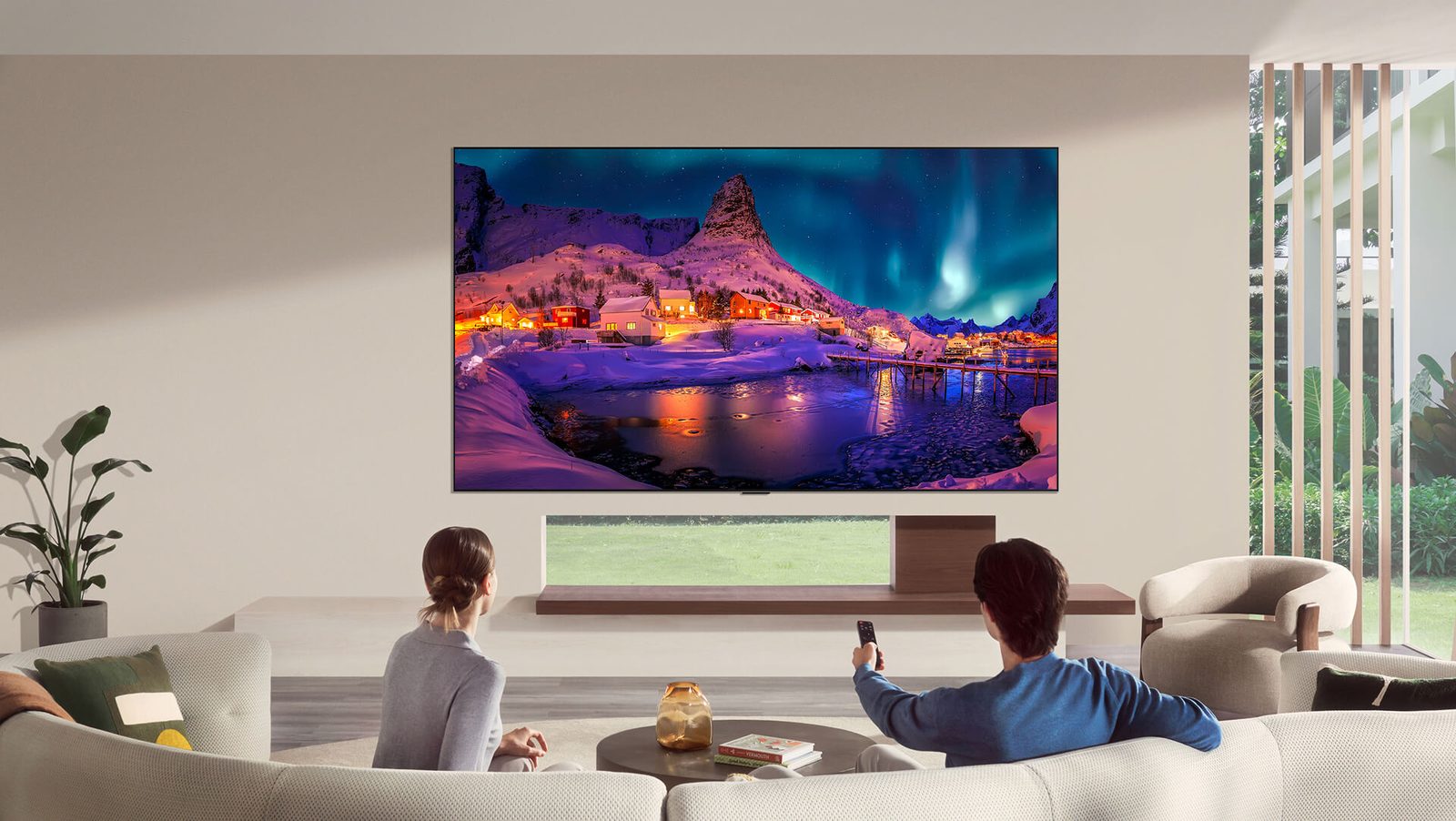
WOLED or QD-OLED: the two families
| WOLED | QD-OLED | |
|---|---|---|
| Panel maker | LG Display | Samsung Display |
| Principle | White pixels + colour filters (red, green, blue, white) | Blue pixels + quantum dots that create the red and green |
| Found in | LG, Philips, Panasonic, Sony Bravia 6, some Samsung sizes | Samsung (S95H, S92H…), Sony Bravia 8 II |
| Strengths | Very deep blacks even in a lit room, wide choice of sizes (42 to 97 inches) | Very bright, saturated colours, exceptional viewing angles |
| Drawback | Colours slightly less vivid at very high brightness (except 2026 Tandem panels) | Blacks can look slightly greyed in bright daylight (except matte screens) |
In 2026, the two technologies are neck and neck at the top end. The choice comes down more to brand, operating system, HDR formats and price.
What changes in 2026: Tandem panels
OLED's historic weak point was brightness. The new panels stack several layers of light (these are called Tandem or “Primary RGB Tandem” panels) to go much higher, with purer colours:
- LG G6 : second-generation Tandem panel, even brighter than the G5; the C6 benefits in 77 and 83 inches.
- Samsung S95H : latest-generation QD-OLED, very bright, with an anti-glare matte finish.
- Philips OLED+ 911 and 951 : Tandem panel and Ambilight on four sides.
Another advance: the refresh rate goes up to 165 Hz on several models (LG C6 and G6, Philips OLED811), a real plus for PC gamers.
Burn-in: the truth
Burn-in is a ghost image that remains visible when a static image has been displayed for too long. It exists, but only under specific conditions: the same logo or the same interface, displayed for hundreds of hours.
- 2026 TVs protect themselves: imperceptible pixel shifting, logo dimming, automatic panel maintenance in standby.
- Leave the TV plugged in : that is when it carries out this maintenance.
- If you leave a news channel on for ten hours a day, or use the TV as a computer monitor all day, a Mini LED Mini LED is the more reassuring choice.
OLED is the heart's choice for films and series in the evening. But if your living room is bathed in sunshine and the TV runs all day, I'd point you towards a Mini LED instead. There's no bad technology, only technologies that suit your home more or less.
The 2026 OLED ranges by brand
| Brand | Entry level | Mid-range | High end |
|---|---|---|---|
| LG | B6 | C6 | G6, W6 Wallpaper |
| Samsung | S85H | S92H | S95H, S99H |
| Philips | OLED761 / 801 | OLED811, OLED851 | OLED+ 911, OLED+ 951 |
| Sony | Bravia 6 | — | Bravia 8 II (2025 model, still in the range) |
Our comparison of the year's best OLEDs: LG C6, Samsung S92H, Philips OLED811 and Sony Bravia 6.
Frequently asked questions
Does burn-in still exist in 2026?
Yes, but it mainly affects static images displayed for hundreds of hours: a news channel logo on all day, the interface of a game played every day for hours, use as a computer monitor. For varied family use, the risk is low thanks to built-in protections.
Is an OLED bright enough for a bright living room?
Entry-level models may lack brightness next to a picture window. High-end 2026 OLEDs (LG G6, Samsung S95H, Philips OLED+) are much brighter and have an anti-glare finish. Otherwise, a Mini LED is more suitable.
How long does an OLED last?
Current panels are rated for tens of thousands of hours, which is well over ten years at a few hours a day. Leave the TV plugged in so it can carry out its standby maintenance.
Why don't OLEDs come in 32 inches?
The smallest common OLED TV is 42 inches. Below that, you'll find monitors or LCD TVs.
Come and compare the screens in person
At our Temploux shop, we switch on TVs side by side with your content. Or ask our expert salesperson online, right now.
Read next
 ComparisonOLED, Mini LED or RGB Mini LED: which to choose?It's the question everyone asks in front of the TV aisle. There's no outright winner: there's the technology that suits your living room and your habits. Here's our comparison, criterion by criterion, and our clear verdict.2 min read
 Comparison2026 OLED comparison: LG, Samsung, Sony or Philips?Ten OLED series are competing for your living room in 2026, from €1,199.99 to over €5,000. They all have perfect blacks; what sets them apart is brightness, anti-reflection, HDR format, gaming, sound and system. Here's our full comparison, with store prices and a clear verdict for each type of viewer.7 min read
 TechnologyLED, QLED, Mini LED: LCD screens explainedQLED, Neo QLED, QNED, Mini LED, SQD… all these names belong to one family: the LCD screen. What makes the difference is how it's lit. We explain everything so you can read a spec sheet like a salesperson.2 min read