
Choosing your dishwasher well: freestanding, integrated, 45 or 60 cm
Three in four Belgians have a dishwasher, and it lasts nearly twelve years on average. Before choosing one, you need to know where it will go, how many place settings you need and what noise level you can accept. The rest, drying and options, makes the difference in price.
- Format : freestanding, integrated (visible control panel) or fully integrated
- 60 cm and 13-14 place settings for a family, 45 cm for a small kitchen
- Quiet in open-plan kitchens: under 42 dB
- Drying: auto-open or zeolite, the real advantage
Step 1: the format, depending on your kitchen
That's the question that shapes everything else. A dishwasher isn't chosen like a fridge: it has to fit a specific recess and match your furniture.
| Type | Description | Key takeaway |
|---|---|---|
| Freestanding | Appliance with its own finish and worktop | Can be placed anywhere, and taken with you when you move |
| Semi-integrated | Freestanding without the top, slid under the worktop; the control panel and the appliance front remain visible | Check the height without the top |
| Fully integrated | The control panel stays visible; a furniture front covers the rest of the door | The control panel needs to match the kitchen |
| Fully integrated | Controls on the top edge of the door, full furniture front | The most common in a fitted kitchen |
| Compact (countertop) | 45 cm high, around 6 place settings | For very small spaces |
The classic trap: confusing integrated and fully integrated. The first leaves the control panel visible, the second is fully hidden. Details on measurements, hinges and recesses are in our built-in or freestanding page.
Step 2: 45 or 60 cm, and how many place settings
A 'place setting' is a standardised unit (plates, glass, cutlery for one person). In practice, allow generously: a saucepan or a dish takes up the space of several place settings.
| Burner | Tip |
|---|---|
| 1 to 2 people, small kitchen | 45 cm (9 to 10 place settings), or 60 cm run at half load |
| 3 to 4 people | 60 cm, 13 to 14 place settings |
| Large family, big saucepans | 60 cm, 14 to 16 place settings, third rack, tall height if the recess allows |
In our range, the Beko DVS05030W is a 45 cm model with 10 place settings (€379.99), while the Hisense HS672B90B holds 14 place settings in 60 cm (€499.99). Some 60 cm models go up to 16 place settings, such as the Haier XF6C2M1PW (€799.99) according to its reference.
Step 3: the noise
In an open-plan kitchen that flows into the living room, noise often matters more than energy use. Today's dishwashers range from around 38 to 49 dB.
- Under 42 dB : very quiet, ideal for open-plan kitchens (Bosch SMS6ECC12E at 42 dB, Whirlpool WIO3T141PS at 41 dB according to their spec sheets).
- 43 to 45 dB : fine for a closed kitchen (Hisense HS672B90B at 44 dB).
- 46 dB and above : best run at night or while you're out (Beko DVS05030W at 49 dB).
Many models have a quiet or night mode, which lowers the noise by a few more decibels but lengthens the cycle. On the label, a noise class from A to D accompanies the dB value.
Step 4: the energy label
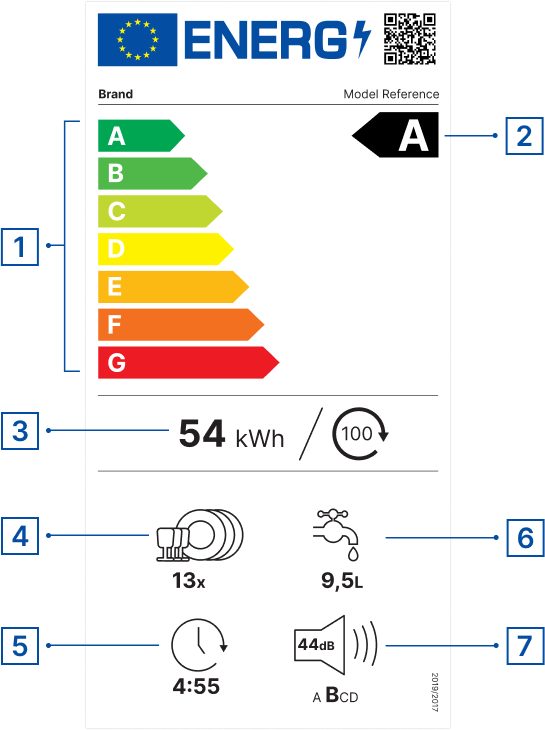
As with laundry, the scale has run from A to G since 2021, and everything is measured on the Eco, which takes longer because it heats less. Class A remains rarer than for washing: B and C are very good levels, D and E are found at entry level.
| Example | kWh per 100 cycles | Annual cost (220 cycles, €0.35/kWh) |
|---|---|---|
| Class A (Bosch SMS6ECC12E, 54 kWh according to its spec sheet) | 54 | ≈ 42 € |
| Class D (Beko DVS05030W, 67 kWh according to its spec sheet, 45 cm) | 67 | ≈ 52 € |
| 60 cm dishwasher, more energy-hungry | ≈ 75 | ≈ 58 € |
The annual difference is only around €15 to €20. Over twelve years it adds up, but comfort (noise, drying, racks) often weighs more on day-to-day satisfaction.
Step 5: drying, where everything is decided
Residual heat or heat exchanger
The tub cools and the steam condenses on it. Fine on glass and porcelain, weak on plastic.
Entry level
Automatic door opening
The door opens slightly at the end of the cycle to let the steam escape. Simple and very effective. Names: EfficientDry (Bosch), autoOpen dry (Siemens), Auto Open Door (Samsung), NaturalDry (Whirlpool), SelfDry (Beko).
From the mid-range upwards
Zeolite
A mineral placed at the bottom of the tub absorbs moisture and releases it as dry heat. The best drying, including on plastic. Names: PerfectDry (Bosch), Zeolith (Siemens).
Bosch SMV6ZCX03E, €1,239.99
Step 6: the racks and useful options
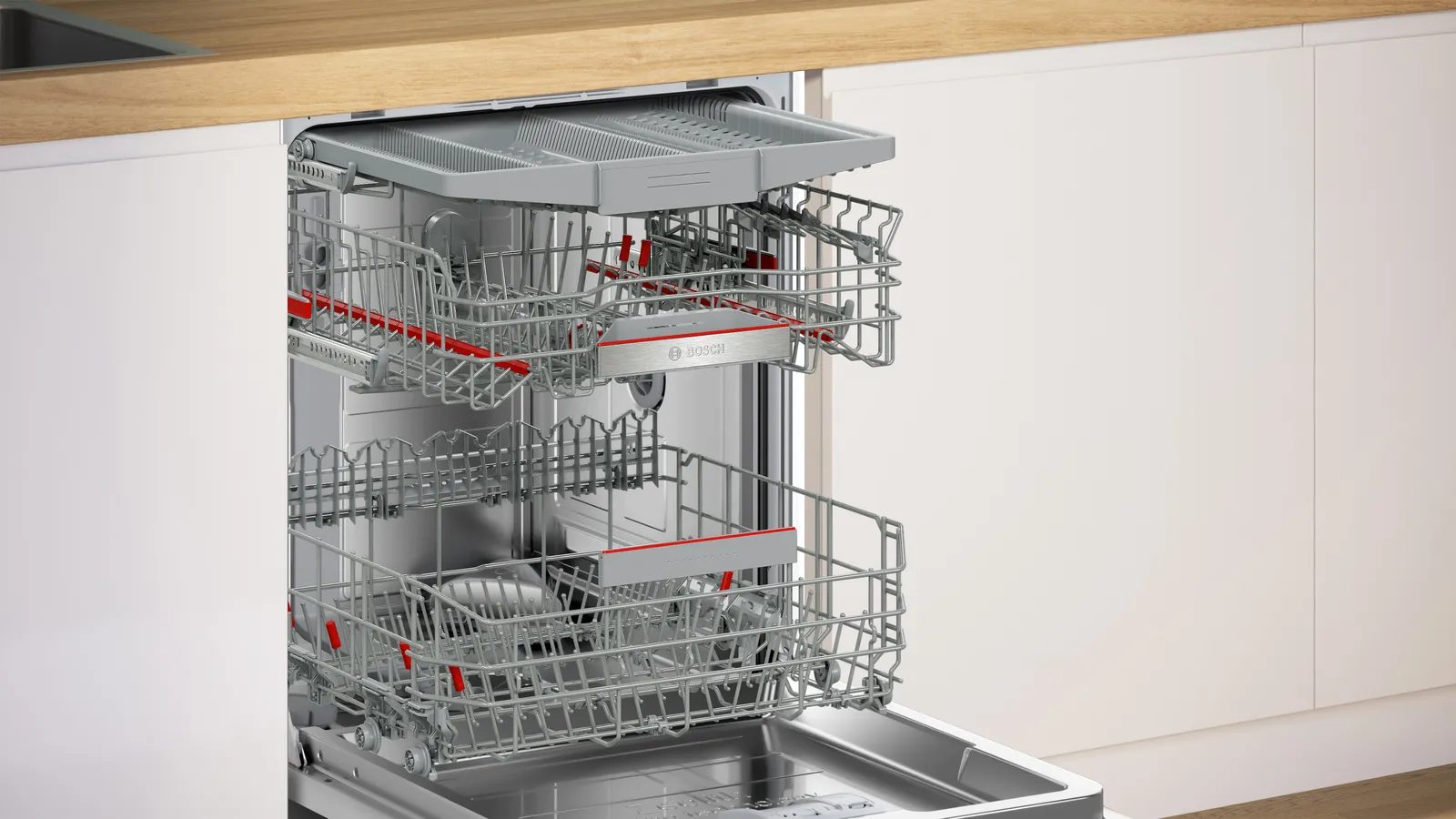
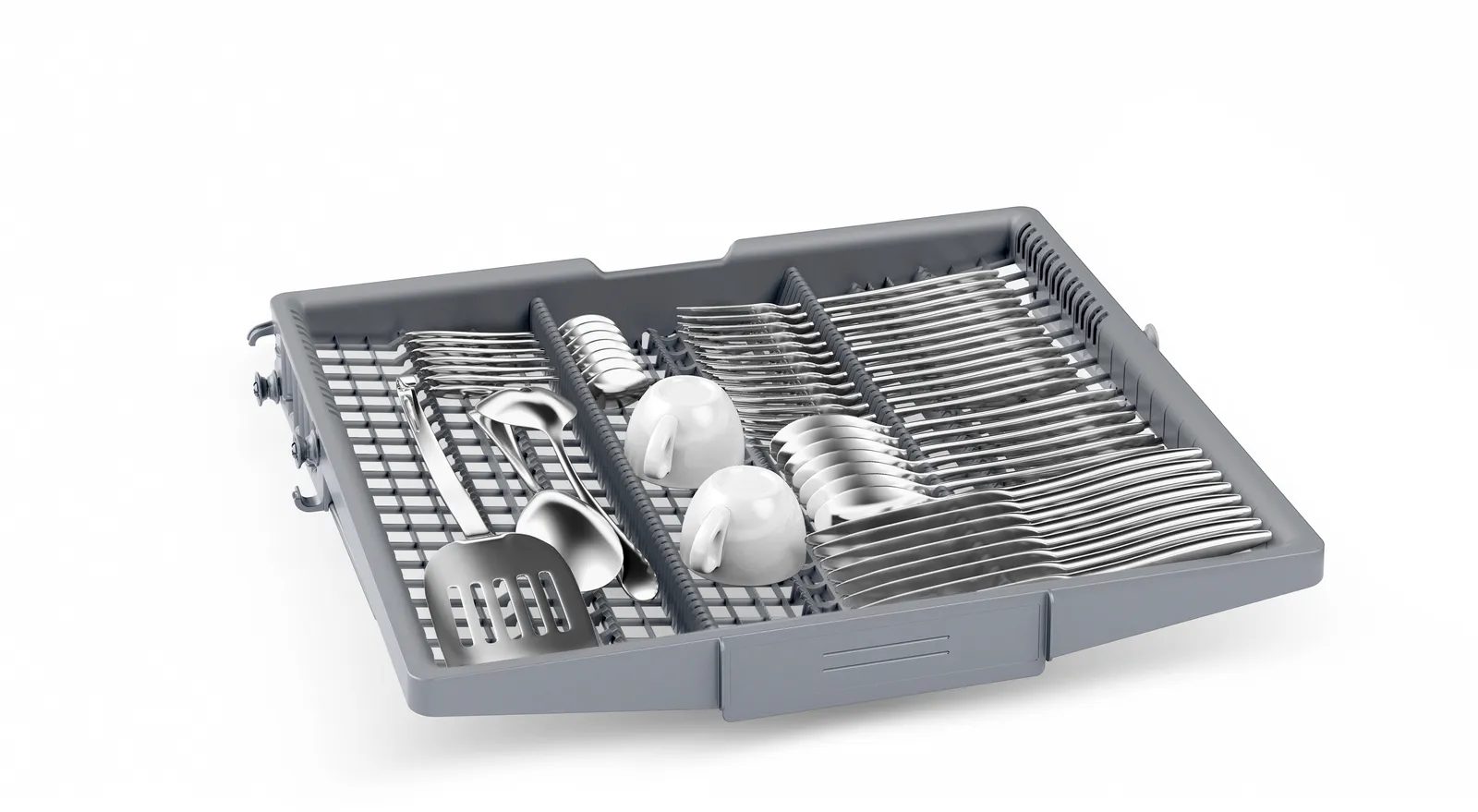
- The third level (cutlery drawer) : cutlery lies flat at the top, freeing up space at the bottom. Very popular, and quickly becomes indispensable.
- The adjustable upper rack, even when loaded, to fit large plates or stemmed glasses.
- The folding spikes for saucepans and salad bowls.
- Full leak protection (AquaStop or equivalent): highly recommended, especially in a flat.
- The Auto programme sensor-based, which adjusts water and temperature to how dirty the load is.
- Floor projection (light spot or time remaining) on fully integrated models, since the door hides the controls.
- Automatic dosing available on some brands (Hisense, Haier), and connectivity to start the cycle during off-peak hours or with your solar panels.
Measure your recess before you come: the height under the worktop (usually 82 cm), the width and the height of your plinth. And if you're replacing a fully integrated model, note the hinge type: it determines whether your kitchen door will refit without trouble on the new appliance.
What budget?
Freestanding
| Model | Key points | Public price |
|---|---|---|
| Beko DVS05030W | 45 cm, 10 place settings, energy class D, 49 dB | 379,99 € |
| Hisense HS642D90B | 60 cm, 14 place settings, energy class D, brushless motor | 499,99 € |
| Hisense HS672B90B | 60 cm, 14 place settings, energy class B, 44 dB, Wi-Fi | 499,99 € |
| Haier XF6C2M1PW | 60 cm, 16 place settings, energy class C based on its model number | 799,99 € |
| Bosch SMS6ECC12E | 60 cm, 14 place settings, energy class A, 42 dB, EfficientDry, Home Connect | 1 239,99 € |
Integrated and fully integrated
| Model | Key points | Public price |
|---|---|---|
| Hisense HV642C65 | Fully integrated 60 cm, energy class C | 599,99 € |
| Bosch SMV2ITX18E | Fully integrated, Series 2 | 699,99 € |
| Bosch SMI4HCB07E | Integrated (visible control panel), Series 4 | 969,99 € |
| Bosch SMV6ZCX03E | Fully integrated, Series 6, zeolite drying PerfectDry | 1 239,99 € |
| Siemens SN75EX23CE | Fully integrated iQ500, varioHinge hinge, autoOpen dry | 1 279,99 € |
Prices recorded on nimestore.com on 15 October 2026: the product page prevails, and Nimesclub members often get a reduced price (sometimes very significantly on certain built-in models). Specifications are based on the manufacturers' product sheets or on reading their model numbers: check the product page before buying.
Each brand has its own strengths: Bosch and Siemens for zeolite drying and the wide choice of built-in models, Hisense and Beko for price, Whirlpool for its MaxiSpace tubs. For maintenance, see our advice, and if something goes wrong, our faults page.
Our dishwashers in store
 Dishwasher BEKO DVS05030W€315.00
 Dishwasher HISENSE HS672B90B€433.00
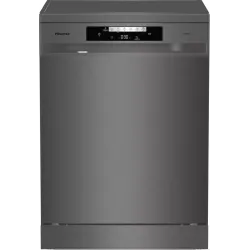 Hisense HS642D90B Dishwasher€375.00
 Bosch SMS6ECC12E Dishwasher€1,239.00
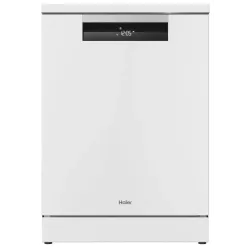 Dishwasher HAIER XF6C2M1PW€599.00
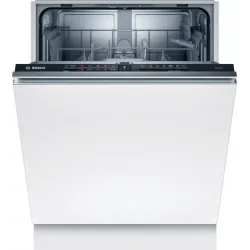 Built-in dishwasher BOSCH SMV2ITX18E€699.00
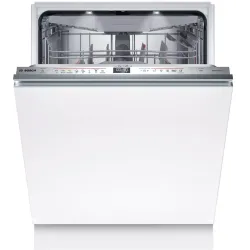 Fully integrated dishwasher BOSCH SMV6ZCX03E€1,239.00
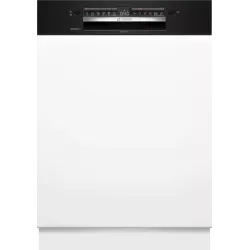 Built-in dishwasher BOSCH SMI4HCB07E€969.00
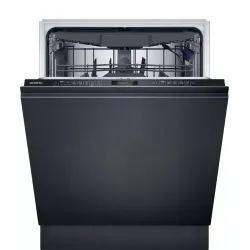 Built-in dishwasher SIEMENS SN75EX23CE€1,279.00
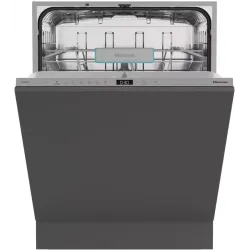 Built-in dishwasher HISENSE HV642C65€599.00
All models are on the shop floor freestanding dishwashers and built-in dishwashers. To see the racks in person, pop into our Temploux store.
Frequently asked questions
What's the difference between integrated and fully integrated?
On an integrated model, the control panel stays visible at the top of the door, under the worktop; the cabinet door covers the rest. On a fully integrated model, the controls are on the edge of the door and the cabinet door hides everything. The two are not interchangeable.
How much does a dishwasher use?
A recent model uses around 9 to 10 litres of water and 0.5 to 0.8 kWh per Eco cycle, so roughly €40 to €60 of electricity a year for 220 cycles at €0.35 per kWh. That's less water than washing up by hand for the same amount of crockery.
Do I need to rinse dishes before putting them in the dishwasher?
No. Just scrape off leftovers with a fork or spatula. Rinsing under hot water wastes water and energy, and the sensors in modern machines cope very well without it.
Why does plastic come out wet?
Plastic retains less heat than glass or porcelain: water condenses on it and dries less well. It's just physics. A door left slightly ajar at the end of the cycle or zeolite drying noticeably improves the result.
Is a 45 cm model worth it for two people?
Yes, if space is tight. Otherwise, a 60 cm used on a half load or filled every two days is often more versatile: large plates, dishes and saucepans fit in more easily.
Come and see the appliances in person
At our Temploux shop, we open the doors and compare drums and finishes. Or ask our expert sales adviser online, right now.
Read next
 Buying guideBuilt-in, integrated or freestanding: dishwashers, fridges and ovensWhether it's a new kitchen or a simple replacement, the question always comes up: appliance hidden behind the units or freestanding? Each option has its advantages, but built-in appliances don't forgive approximation. Here are the terms not to confuse, the standard niche sizes and the measurements to take before coming to the shop.6 min read
 PracticalMaintaining your washing machine and dishwasher: the habits that make them lastA well-maintained washing machine or dishwasher cleans better, uses less energy, smells fresher and lasts longer. Good news: a few minutes a month is all it takes. Here are the habits, appliance by appliance, with a simple schedule to keep handy.6 min read
 PracticalWashing machine or dishwasher broken down: what should you check before calling customer service?A machine that shows an error code or won't drain is often less serious than it seems. Many 'breakdowns' can be fixed in ten minutes with a filter, a hose or a setting. Here's what you can check yourself, safely, and how to decide between repair and replacement.6 min read