
Hisense technologies explained: RGB MiniLED, Hi-View, Devialet
RGB MiniLED, ULED, Hi-QLED, Hi-View AI Engine: Hisense loves its marketing names. Behind each one lies a real technology, more or less useful depending on how you watch. We translate it all into plain English, with what it actually changes in front of the screen.
- RGB MiniLED : separate red, green and blue LEDs
- Hi-View AI Engine : the processor, in three tiers
- Sound Devialet and Dolby Atmos on the 2026 Mini LEDs
- Gaming: up to 180 Hz, VRR, ALLM and Game Bar
Panels: from LED to RGB MiniLED
All Hisense 2026 TVs sold in Europe are LCD screens LCD : a panel filters the light from a backlight behind it. What changes from one series to the next is how the image is lit. And that is what makes all the difference in brightness, contrast and colours.
Direct LED (A5S, A7S)
LEDs spread behind the screen, with no fine zoning of the light. The picture is decent and even, but blacks look greyish in a dark room. Hisense adds some quantum dots (nanocrystals that make colours more vivid) and calls them “Hi-QLED”.
Mini LED, or “ULED” (U7SE, U7S Pro)
Much smaller and more numerous LEDs, grouped into hundreds of zones that switch on and off depending on the picture: this is local dimming (local dimming). The result: deeper blacks, dazzling whites and a real HDR effect. “ULED” is Hisense's own name for its high-end Mini LED. Drawback: a slight halo can appear around white subtitles on a black background.
RGB MiniLED (UR8S, UR9S)
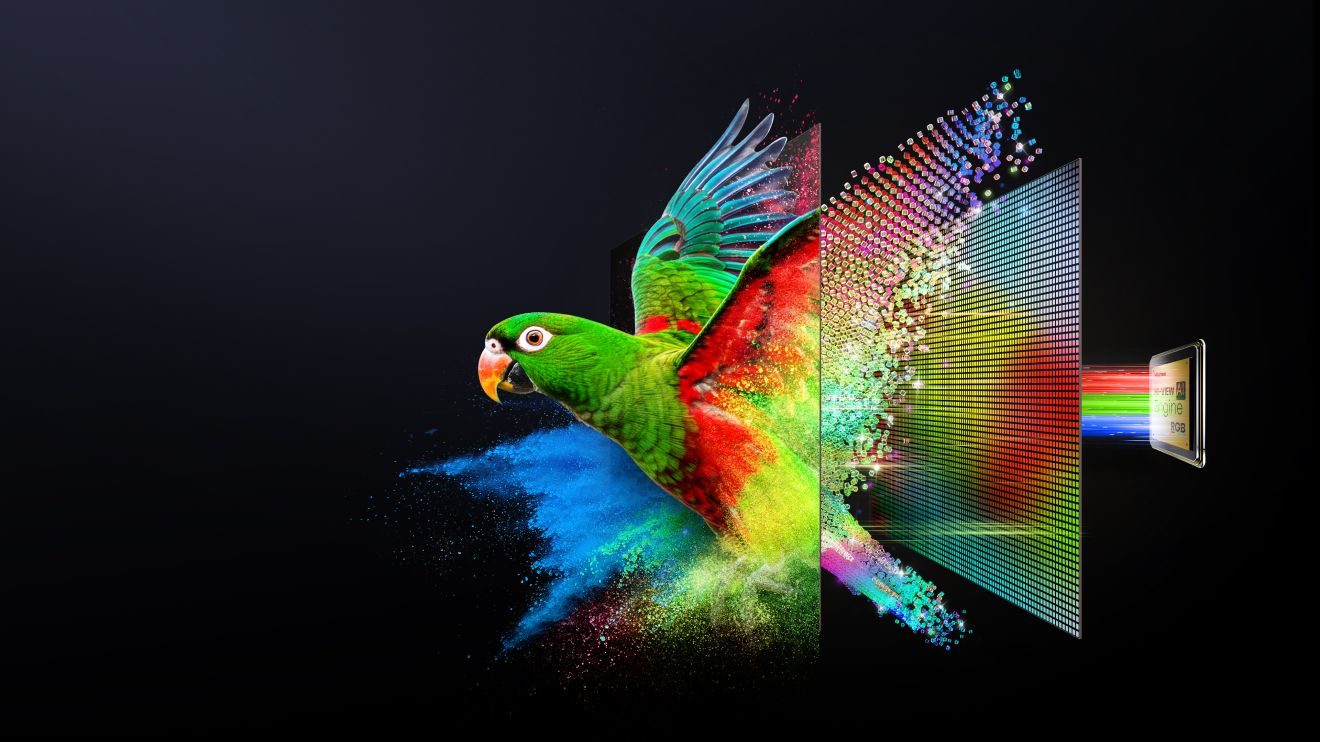
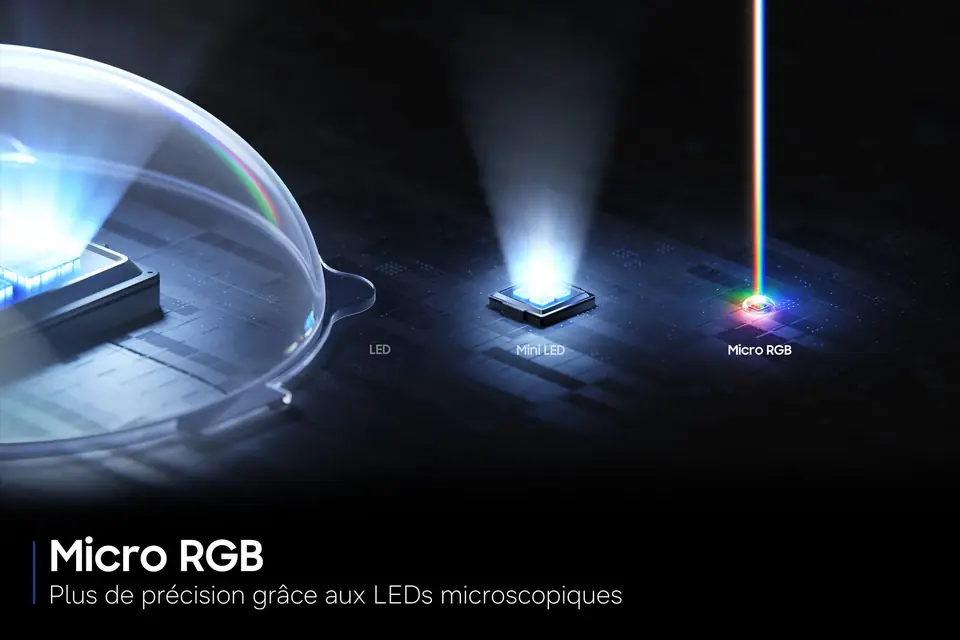
The big news for 2026. Instead of blue LEDs converted by quantum dots, the backlight uses separate red, green and blue LEDs, controlled zone by zone. Colours stay pure even at very high brightness (Hisense claims up to 100% of the BT.2020 colour space on the UR9S). It is still LCD: no risk of burn-in, unlike OLED. Downside: a slight coloured halo can appear near very bright areas, and viewing angles are not as good as OLED. To go further, read our article on RGB Mini LED.
VA or IPS panel
The U7SE uses a panel VA (very good head-on contrast, picture washes out at the sides) in 50, 55 and 85 inches, and a panel IPS (better viewing angles, weaker contrast) in 65 inches according to the specialist press. With a corner sofa, ask us to check the panel of the size you choose.
The Hi-View AI Engine processor
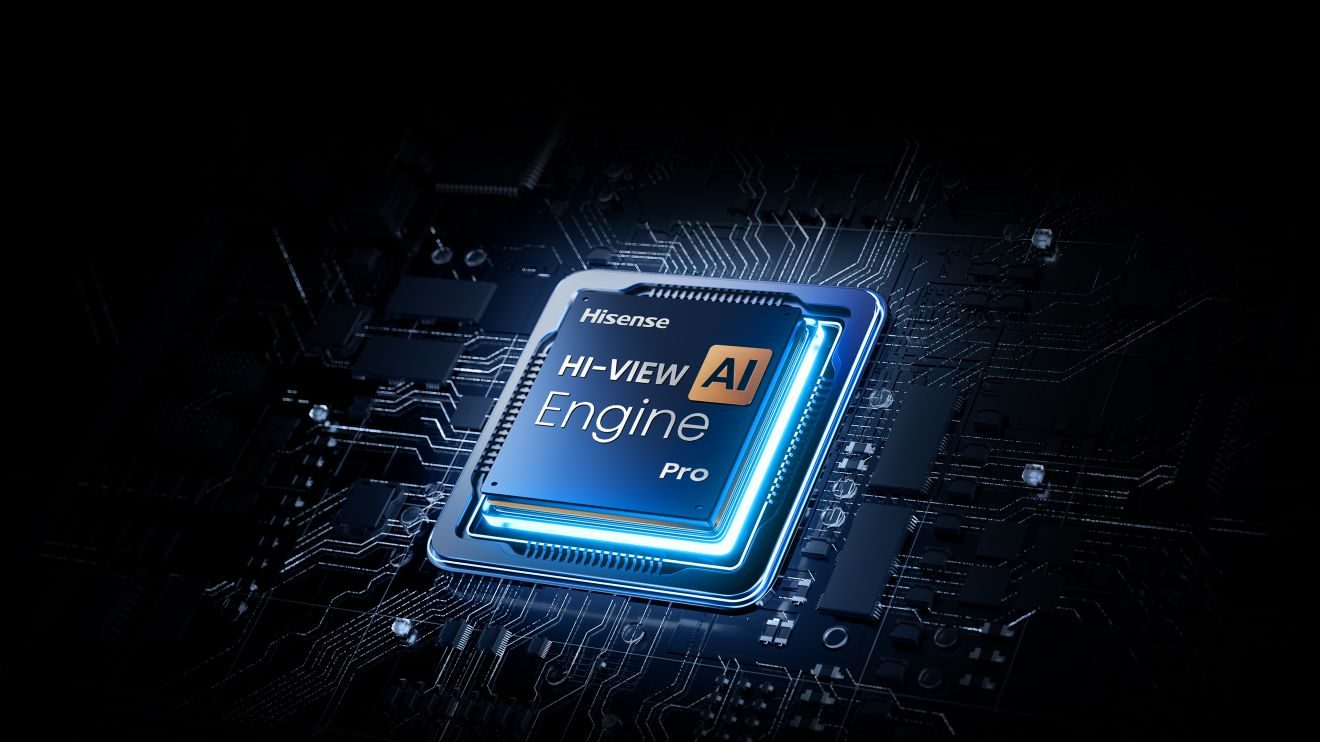
It's the TV's brain. It upscales images to 4K, recognises scenes (faces, landscapes, sport), adjusts contrast and colours frame by frame and manages motion smoothness. It comes in three levels, based on MediaTek Pentonic chips according to the press:
| Processor | Series | What it changes |
|---|---|---|
| Hi-View AI Engine RGB | UR9S, UR8S | RGB LED control, Dolby Vision 2 |
| Hi-View AI Engine Pro | U7S Pro (and 100U7Q from 2025) | Finer processing; Dolby Vision 2 on the U7S Pro |
| Hi-View AI Engine | U7SE | Good processing, but no Dolby Vision 2 |
Picture processing and HDR
- Dolby Vision IQ : Dolby Vision (scene-by-scene HDR, used by Netflix and Disney+), which adapts to the room's light thanks to the light sensor.
- Dolby Vision 2 : the new generation, offered by Hisense first since August 2026. It refines the picture adaptation further. Reserved for the UR9S, UR8S and U7S Pro.
- HDR10+ and HDR10+ Adaptive : the rival equivalent, used by Prime Video. Hisense supports both formats, unlike LG (no HDR10+) or Samsung (no Dolby Vision).
- IMAX Enhanced : a label for IMAX content (some Disney+ films), with a picture mode and DTS sound to match.
- Filmmaker Mode : switches off artificial processing to respect the image the director intended. Our recommended mode for films.
- AI Sports Mode : a mode that boosts motion smoothness and colours for sport.
- MEMC (AI Smooth Motion) : motion smoothing. Useful for sport, but best reduced for films (the ‘soap opera effect').
The HDR is explained in detail in our article on Dolby Vision and HDR10+.
Anti-glare: the matt panel
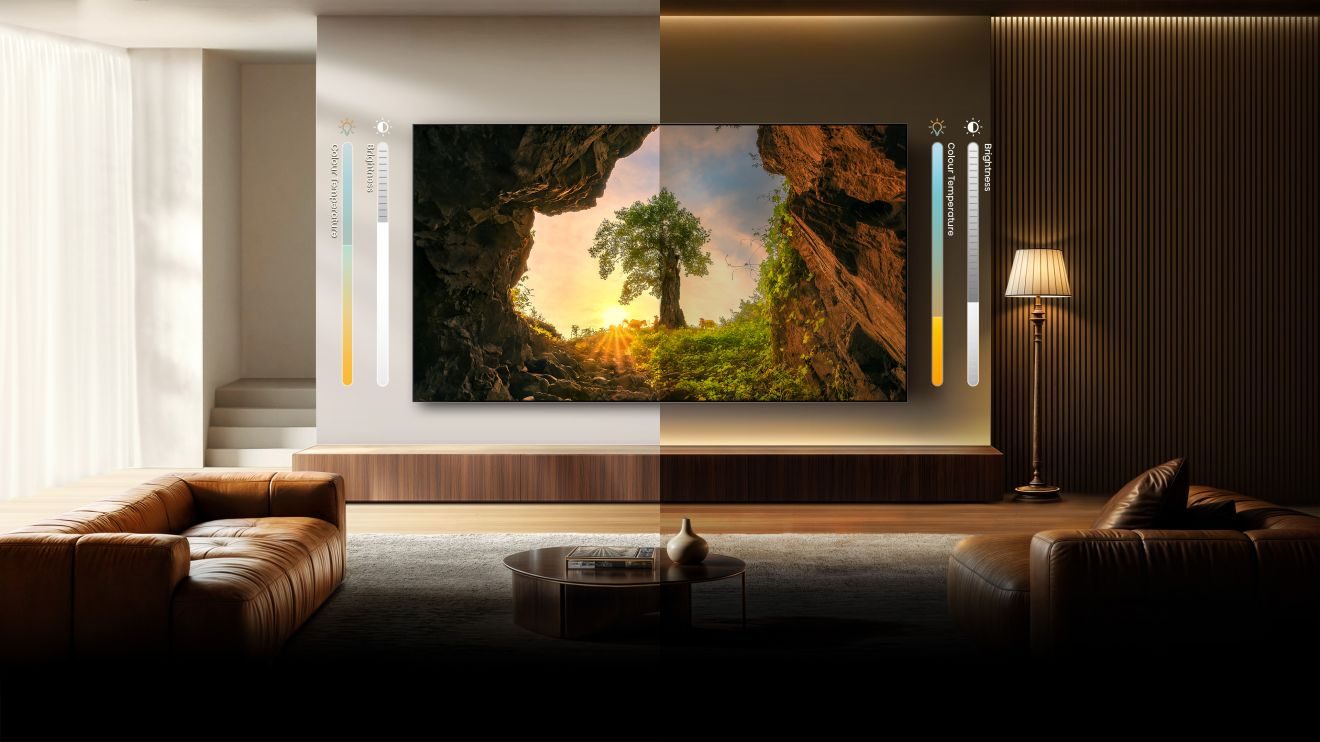
The UR9S, UR8S and U7S Pro have a ‘matte, anti-reflective panel' : the surface diffuses light from windows instead of reflecting it like a mirror. Facing a picture window, this is decisive. The U7SE, A7S and A5S don't have this treatment: best placed with their back to the light.
Sound: Devialet, Atmos and Hi-Concerto
- ‘Tuned by Devialet' : the sound of the 2026 Mini LED and RGB MiniLED models has been tuned with Devialet, the French high-end hi-fi brand. It's not an integrated Devialet speaker, but a carefully tuned setting.
- Power : 40 W with built-in subwoofer on the U7SE, 50 W on the U7S Pro and UR8S, 90 W on the UR9S in 85 inches (official spec sheets). 20 W on the A7S.
- Dolby Atmos : three-dimensional sound, found across the whole range.
- Hi-Concerto : makes the TV's speakers and a compatible Hisense soundbar play together.
- eARC on the HDMI 3 port: to connect a soundbar and pass through Dolby Atmos.
Gaming features
- 144, 165 or 180 Hz native : reserved for PC. PS5 and Xbox Series X consoles stop at 4K 120 Hz, and all our Hisense Mini LEDs do too.
- VRR and AMD FreeSync Premium Pro : eliminates screen tearing. Note that on the U7SE, it's only on HDMI 3 and 4.
- ALLM : the TV switches to game mode automatically when the console turns on.
- Game Mode Pro / Ultra and Game Bar : a gaming menu showing refresh rate, VRR status and quick settings.
- Dolby Vision Gaming and HDR10+ Gaming : HDR tailored for gaming (Dolby Vision gaming with the Xbox Series X).
- Input lag : 7 to 8 ms claimed at 4K 120 Hz on the Mini LEDs, 11 ms on the A7S. That's excellent.
Don't be won over by 180 Hz if you play on console: a U7SE at 120 Hz performs just as well as a UR8S for PS5 in terms of smoothness. What will make the difference is brightness, anti-glare and colours.
These technologies in store
 MINILED TV HISENSE 55UR8S€1,296.00
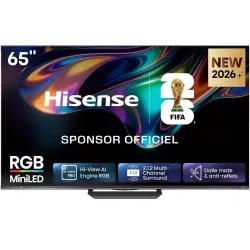 MINILED TV HISENSE 65UR8S€1,481.00
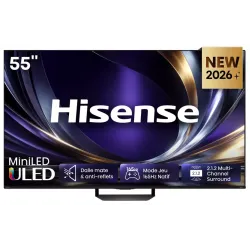 Mini LED TV HISENSE 55U7SPRO€1,299.00
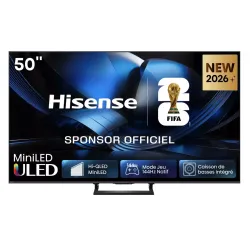 Mini LED TV HISENSE 50U7SE€595.00
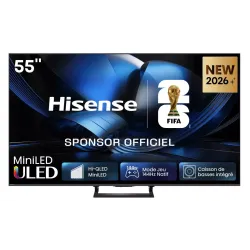 Mini LED TV HISENSE 55U7SE€700.00
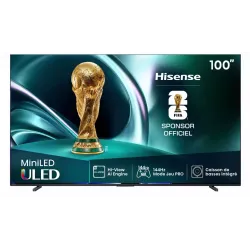 Mini LED TV HISENSE 100U7Q€1,992.00
 TV QLED HISENSE 43A7S€398.00
What really matters, and what matters less
With all these technologies, here is our salesperson's ranking, from most to least important for most customers:
- Brightness and anti-glare, if your room is bright: this is what most clearly separates a U7SE from a U7S Pro.
- Local dimming (Mini LED): it delivers deep blacks and the real HDR effect. An A7S doesn't have it.
- Dolby Vision and HDR10+ : found on all Hisense 4K TVs, a real advantage over LG or Samsung.
- RGB MiniLED : a visible plus for colours, especially at very high brightness.
- 144 to 180 Hz : only useful on PC. For a console, 120 Hz is enough.
Hisense-specific design and features
- Very thin bezels (around 1 to 2.5 mm on three sides, according to the spec sheets) and a central stand on many models: handy on a narrow piece of furniture.
- VIDAA : the in-house system, fast and simple, with voice control, AirPlay 2, screen sharing (EzPlay) and smart home compatibility (‘Smart Home ready').
- Laser TV : Hisense also specialises in ultra-short-throw laser projectors, a niche for 100 to 150-inch screens. Not sold in our stores.
The Hisense glossary, translated into plain English
| Marketing name | In plain terms |
|---|---|
| RGB MiniLED | Backlighting by separate red, green and blue LEDs (UR8S, UR9S) |
| ULED | Hisense's high-end Mini LED, with local dimming |
| Hi-QLED | Screen with quantum dots for more vivid colours |
| Hi-View AI Engine (Pro, RGB) | The picture processor, in three tiers |
| Dolby Vision IQ | Dolby Vision that adapts to the room's light |
| Dolby Vision 2 | New generation of Dolby Vision, via software update |
| HDR10+ Adaptive | HDR10+ that adapts to the room's light |
| 4K HDR Immersive | Commercial name for HDR compatibility |
| Tuned by Devialet | Sound tuned with the Devialet hi-fi brand |
| Hi-Concerto | TV and Hisense soundbar playing together |
| AI Smooth Motion / MEMC | Motion smoothing |
| AI Sports Mode | Picture mode for sport |
| Game Mode Pro / Ultra | Game mode with high refresh rate and VRR |
| Game Bar | Quick menu during gaming (Hz, VRR, settings) |
| EzPlay | Smartphone screen sharing |
| VIDAA | Hisense's own Smart TV system |
| HSR (High Speed Refresh) | "Accelerated" refresh rate through processing on a 60 Hz panel: not a true native 120 Hz |
Frequently asked questions
Is Hisense's RGB MiniLED the same as OLED?
No. It's still an LCD screen, but lit by separate red, green and blue LEDs instead of blue LEDs. Colours are purer and brightness is very high, with no risk of burn-in. OLED keeps better blacks and a better viewing angle.
What is Dolby Vision 2?
The new generation of Dolby Vision. It improves how HDR images adapt to your screen and to the room's lighting. On Hisense, it arrives via update on the UR9S, UR8S and U7S Pro, but not on the U7SE or A7S.
What does Devialet sound do on a Hisense TV?
Devialet, a French hi-fi brand, helped tune the sound of the TVs. This gives a more balanced and clearer sound, but it doesn't replace a real soundbar with a subwoofer for cinema.
Is 180 Hz useful for the PS5?
No. The PS5 and Xbox Series X play at a maximum of 4K 120 Hz. 144, 165 or 180 Hz only matter with a gaming PC. For a console, what matters is having 120 Hz, VRR and ALLM.
Does Hisense have a light sensor?
Yes, the 2026 models we sell have a light sensor. With Dolby Vision IQ, the TV adjusts the picture depending on whether the room is bright or dark.
Come and compare the screens in person
At our Temploux shop, we switch on TVs side by side with your content. Or ask our expert salesperson online, right now.
Read next
 2026 rangeHisense 2026 TV range: all the series explainedThe Hisense 2026 range runs from small Full HD TVs to 100-inch RGB MiniLED. Each series has its place, but the gaps between neighbouring series are sometimes huge. Here is the full breakdown, from top to bottom of the range, with our in-store prices.6 min read
 TechnologyRGB Mini LED, Micro RGB, True RGB: the big new thing for 2026It's THE trend of the year: all the major brands are launching TVs with RGB backlighting. Samsung talks about Micro RGB, Sony about True RGB, and Hisense and TCL about RGB Mini LED. Behind the names is a simple idea that delivers spectacular colours.2 min read
 TechnologyHDR, Dolby Vision, HDR10+: what really changesHDR is what makes the difference between a 'clean' picture and one that really dazzles. But with all the logos, it's easy to get lost. We sort it out for you.3 min read