
TCL technologies: SQD-Mini LED, Halo Control, 288 Hz… everything explained
SQD, WHVA, AiPQ, DLG, Halo Control… TCL loves acronyms. Behind these names are some very real technologies, and a few marketing phrases to take with a pinch of salt. Here is each technology explained simply, with what it really changes in front of your screen.
- SQD-Mini LED : Mini LED with improved quantum dots
- WHVA : the panel with the best viewing angles (C89L 65 inches and up)
- 288 Hz = DLG at reduced resolution, 4K stays at 144 Hz
- A glossary of TCL's marketing names at the end of the page
The basics: TCL makes Mini LED LCD
All TCL TVs sold in Europe in 2026 are screens LCD. The light comes from a backlight behind a liquid crystal panel, which filters that light pixel by pixel. What sets the models apart is the quality of that backlight: number of LEDs, number of separately controlled zones, and colour technology.
The big advantage over OLED: a very high brightness and no risk of burn-in. The drawback: blacks that are less perfect and a possible slight halo around bright objects on a dark background. For the full comparison, see OLED, Mini LED or RGB: which to choose.
TCL backlights
SQD-Mini LED (Super Quantum Dot)
It's the flagship technology of 2026, on the X11L, C89L and C79L. The backlight LEDs remain blue, but they pass through a layer of quantum dots (nanocrystals that convert blue light into very pure red and green) developed by TCL. The announced result: purer colours, around 100% of the BT.2020 space according to TCL, and better light efficiency, so more brightness for the same power consumption.
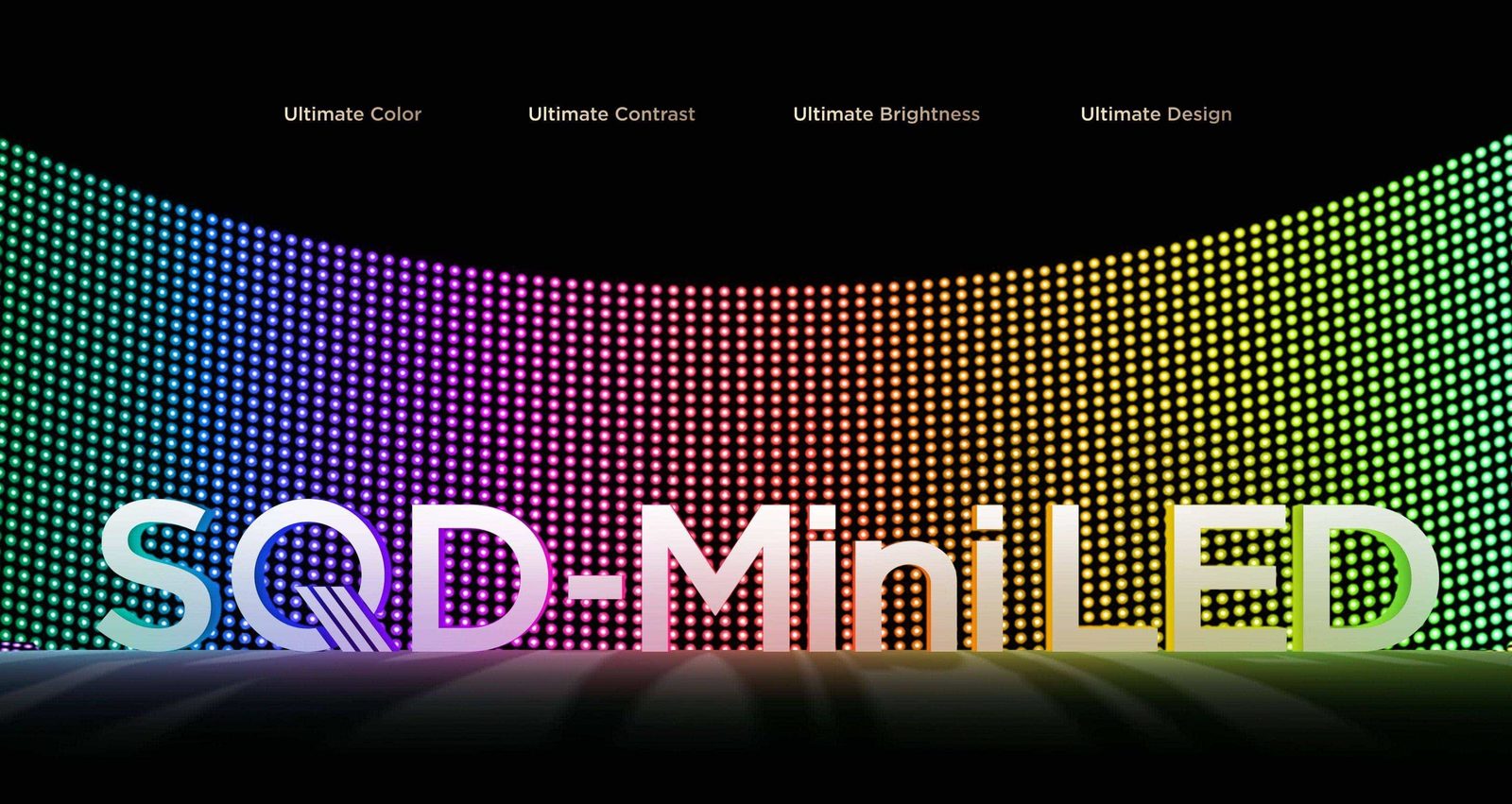
QD-Mini LED
The previous generation, still used on the P89L and on the 2025 models (C6K, C6K Pro, C69K). Same principle, with standard quantum dots and far fewer zones: up to 112 zones on the 85-inch P8L according to TCL, compared with several thousand on a C89L.
RGB Mini LED
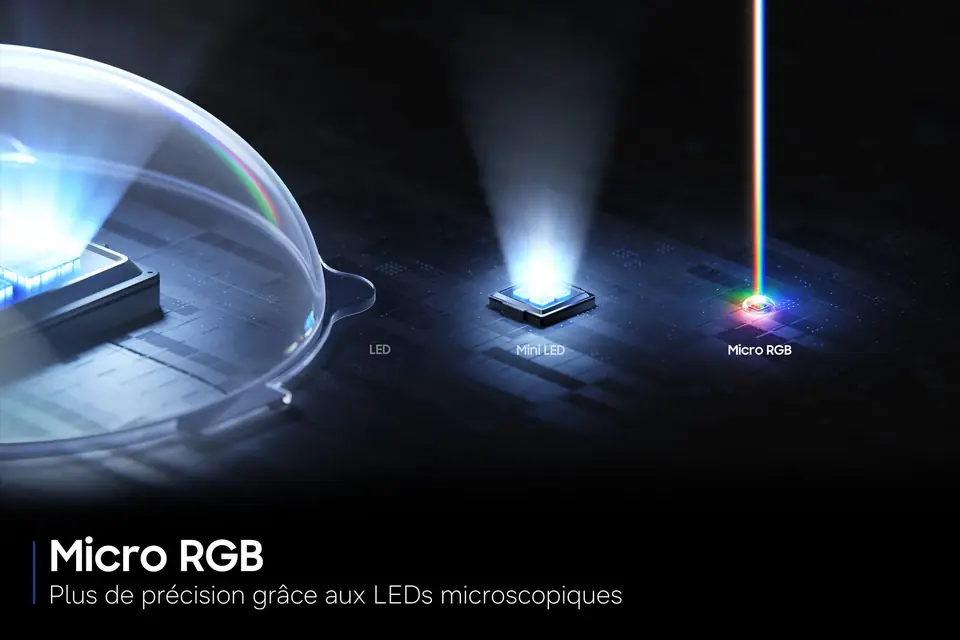
On the RM9L, each LED emits red, green or blue light directly, without a quantum dot film. Colours are very saturated, even at high brightness. It's the equivalent of Samsung's Micro RGB or Sony's True RGB. To understand everything, read our RGB Mini LED guide.
QLED
On the P79L, there is no local dimming: the backlight lights the whole screen as a single block. Colours remain vivid (93% DCI-P3 claimed), but contrast and brightness (400 nits) are those of an entry-level TV. The British press notes that the P7L uses a phosphor-based colour layer rather than true quantum dots.
Panels: WHVA and HVA
TCL makes its panels through its subsidiary CSOT. These are panels of the type VA : excellent native contrast (6,000:1 to 7,000:1 depending on the model), but an image that loses contrast and colour when viewed from the side.
- WHVA 2.0 (W for ‘Wide'): a VA panel with wider viewing angles. On the C89L from 65 to 98 inches and the RM9L. The X11L has an ‘Ultra' version.
- HVA 2.0 Pro : a classic VA panel, very contrasty but with narrower viewing angles. On the C79L and on the 55C89L.
- HVA : on the P89L and P79L.
Contrast and halo: the ‘Halo Control' toolkit
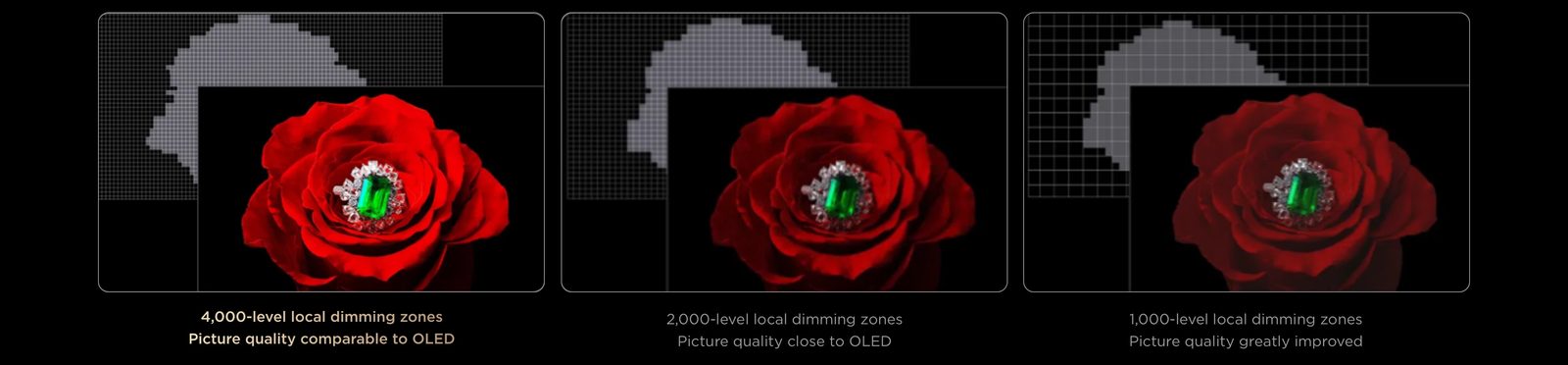
The challenge with Mini LED is blooming : a bright halo around a subtitle or a star on a black background. TCL groups together under the name Halo Control (‘All-domain Halo Control' on the X11L) several techniques:
- Precise Dimming : the number of dimming zones. The more there are, the more precisely the light is localised.
- Micro-OD : the LED layer is brought closer to the panel (reduced optical distance), which limits light scattering. What Hi-Fi notes less halo on the 2026 C8L.
- Condensed micro-lenses : each LED is capped with a lens that focuses its beam.
- 22- to 26-bit backlight control : very fine control of LED intensity, for smoother gradients. On the P8L, TCL specifies 16-bit on 55 and 65 inches, 22-bit on 75 and 85 inches.
Processor and artificial intelligence
The TSR AiPQ (on X11L and C89L) and theAiPQ (on C79L, P89L and P79L) are TCL's image processors. They handle upscaling HD images to 4K, noise reduction, zone control and scene recognition. TCL does not detail the exact chip used.
The AI functions have names ending in ‘Master': AI ClarityMaster (sharpness), AI ColorMaster (colours), AI ContrastMaster (contrast), AI MotionMaster (motion). They improve an average TV picture, but can distort a film: we explain when to turn them off in our TCL settings. Honestly, image processing is a notch below Sony or Samsung, especially with low-quality sources.
HDR: TCL supports all formats
Good news: TCL supports Dolby Vision IQ (Dolby Vision that adapts to the room's light), HDR10+, HDR10 and HLG, plus IMAX Enhanced on the C89L. So Netflix and Disney+ (Dolby Vision) as well as Prime Video (HDR10+) are displayed at their best. The Dolby Vision 2 is promised via update on the C8L/C89L, but is not yet active. More details in our guide to HDR.
Gaming features: 144 Hz, VRR and DLG
- 144 Hz native on the C89L, C79L and P89L: 4K up to 144 frames per second, ideal for PC and perfect for consoles at 120 Hz.
- DLG 288 Hz (‘Dual Line Gate'): doubles the refresh rate by reducing the vertical resolution. This is not 4K at 288 Hz, it's a mode for competitive gaming PCs.
- VRR (variable refresh rate, against screen tearing), ALLM (auto game mode) and AMD FreeSync on the C89L.
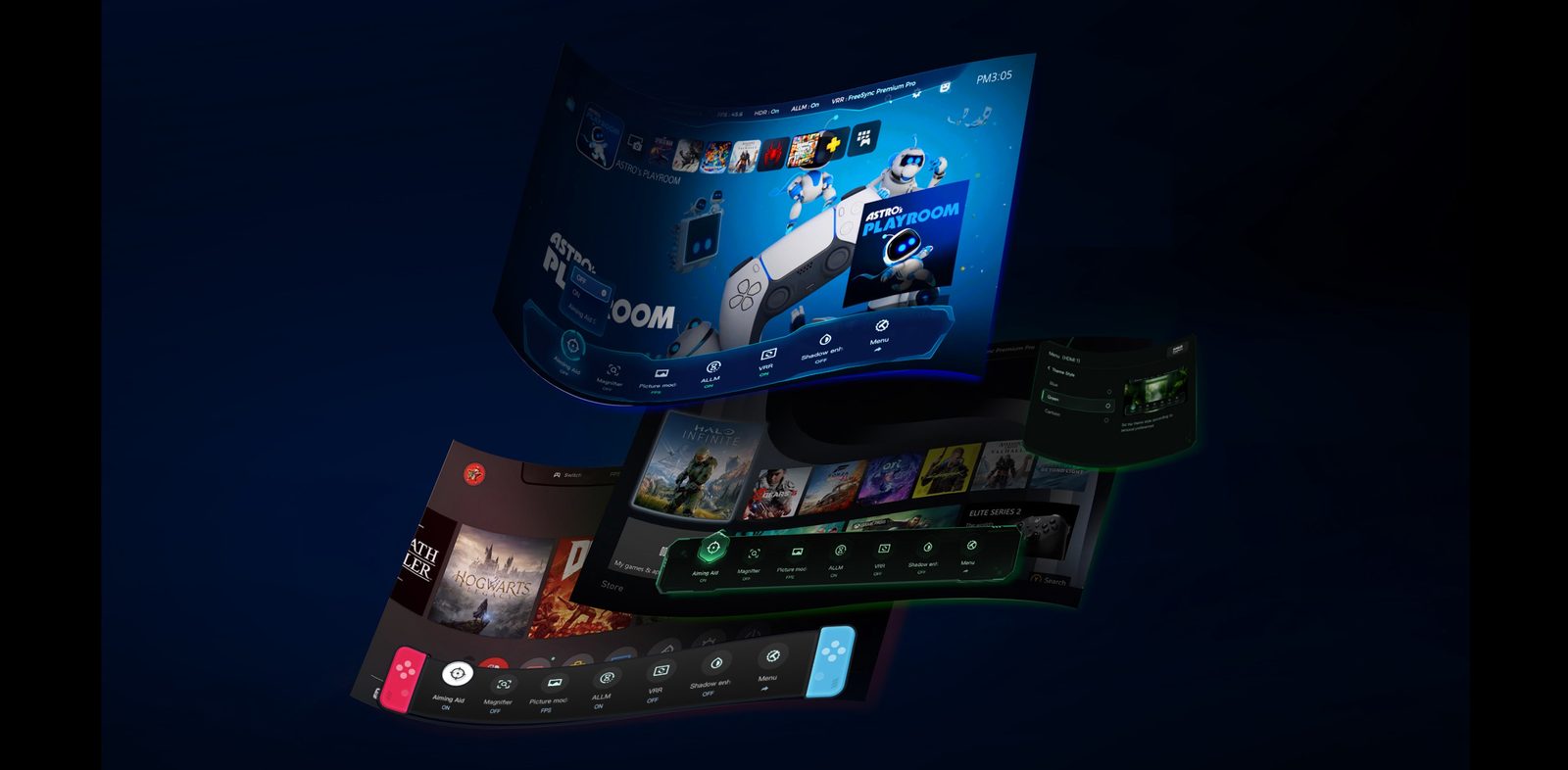
- Game Bar (Game Master): a gaming menu that shows the refresh rate, VRR and quick settings, with displays suited to the major consoles.
The P79L stays in 60 Hz, without FreeSync: avoid for demanding gaming. Our guide gaming TV for PS5, Xbox and PC explains what you really need.
Sound: Bang & Olufsen and Onkyo
The C and X series display ‘Audio by Bang & Olufsen' : an acoustic tuning signed by the Danish brand, not a B&O speaker. On the C89L, the spec sheet lists a system 2.2 with Dolby Atmos and DTS. The P series use a sound Onkyo : 2.1 with subwoofer on the P89L in 65 to 85 inches, 2.0 on the P79L. TCL also offers the Dolby Atmos FlexConnect on some models: the TV pairs with compatible wireless TCL speakers that can be placed freely around the room.
Design and in-house features
- ‘Zero border' design : very slim bezels; the X11L is only around 2 cm thick.
- Art Gallery and AI Art : the TV displays artworks or pre-generated AI images when you're not watching TV.
- Ambience Mode : ambient scenes and sounds (campfire, rain, waves).
- Gemini on Google TV : Google's assistant understands natural requests and can, depending on the model, adjust the picture or sound by voice.
- NXTFrame : TCL's ‘picture frame' TV (the 55A300W in Belgium), with a frame and matte anti-glare screen.
Don't be swayed by the big numbers. The nits and zone counts quoted apply to the largest size in the range: always check the figure for your size. And in store, ask us to show a dark scene with subtitles: that's where you'll see the difference between a P89L, a C79L and a C89L.
These technologies in store
 QLED TV TCL 65C89L€1,799.00
 QLED TV TCL 75C89L€1,615.00
 QLED TV TCL 85C89L€2,003.00
 QLED TV TCL 55C89L€888.00
 TCL 65C79L QLED TV€1,476.00
 QLED TV TCL 75C79L€1,541.00
 LED TV TCL 75P89L€1,067.00
 QLED TV TCL 50P79L€466.00
TCL's glossary, explained
| Marketing name | What it means |
|---|---|
| SQD-Mini LED | Mini LED with enhanced quantum dots (‘Super Quantum Dot') |
| QD-Mini LED | Mini LED with standard quantum dots |
| RGB Mini LED | Backlight with separate red, green and blue LEDs |
| Precise Dimming / LD4000 | The number of local dimming zones (LD4000: around 4,000 zones) |
| Halo Control | The set of techniques against blooming |
| Micro-OD | LEDs placed close to the panel for less blooming |
| WHVA 2.0 / HVA 2.0 Pro | CSOT VA panels; WHVA has better viewing angles |
| TSR AiPQ / AiPQ | TCL picture processors |
| AI MotionMaster | Motion interpolation (MEMC): smooths motion, can create the ‘soap opera effect' |
| DLG 288 Hz | 288 Hz at reduced resolution, for PC |
| 288 VRR Game Accelerator | VRR up to 288 Hz via DLG |
| Game Bar / Game Master | Gaming menu and settings |
| Audio by Bang & Olufsen | Sound tuned by B&O (C and X series) |
| Onkyo 2.1 Hi-Fi | Sound tuned by Onkyo with subwoofer (P series) |
| Dolby Vision IQ | Dolby Vision that adapts to the room's light |
| Dolby Vision 2 (Max) | New generation of Dolby Vision, promised via update |
| Dolby Atmos FlexConnect | Pairs the TV with compatible wireless speakers |
| CSOT | TCL's subsidiary that makes the panels |
Frequently asked questions
SQD-Mini LED or RGB Mini LED: which is best?
TCL itself promotes its SQD-Mini LED for overall picture quality. RGB Mini LED (RM9L series) delivers very saturated colours, but it's reserved for very large sizes and high prices. For most living rooms, a C89L SQD-Mini LED is the best compromise.
Can a TCL TV suffer burn-in like an OLED?
No. TCLs are Mini LED LCDs: there is no risk of burn-in, even with static logos, news channels or video games displayed for hours.
Are TCL's 288 Hz useful for the PS5?
No. 288 Hz is achieved with the DLG technique, which reduces vertical resolution. It's useful for a competitive gaming PC. The PS5 and Xbox Series X go up to 120 Hz, which the C89L, C79L and P89L handle in 4K.
Is the Bang & Olufsen sound on TCL TVs worth a soundbar?
It's an acoustic tuning by Bang & Olufsen, not a B&O speaker. On the C89L, it's clear and good enough for TV and box sets. For a true cinema effect, a Dolby Atmos soundbar is still a plus.
What is the Dolby Vision 2 promised by TCL?
It's the new generation of Dolby Vision, which adapts the picture better to the screen and to the room's light. TCL has promised it via update on the C8L/C89L. As of 15 October 2026, it's only a promise: don't buy it for that reason alone.
Come and compare the screens in person
At our Temploux shop, we switch on TVs side by side with your content. Or ask our expert salesperson online, right now.
Read next
 Brand spaceTCL: everything to know about the brand and its 2026 TVsIn just a few years, TCL has become the reference for bright Mini LED at keen prices. Here's everything you need to know about the brand, its 2026 series sold at Nimestore, its genuine strengths and the limitations a good salesperson will flag to you.6 min read
 TechnologyLED, QLED, Mini LED: LCD screens explainedQLED, Neo QLED, QNED, Mini LED, SQD… all these names belong to one family: the LCD screen. What makes the difference is how it's lit. We explain everything so you can read a spec sheet like a salesperson.2 min read
 TechnologyRGB Mini LED, Micro RGB, True RGB: the big new thing for 2026It's THE trend of the year: all the major brands are launching TVs with RGB backlighting. Samsung talks about Micro RGB, Sony about True RGB, and Hisense and TCL about RGB Mini LED. Behind the names is a simple idea that delivers spectacular colours.2 min read