
Samsung technologies: QD-OLED, Micro RGB, Glare Free explained
QD-OLED, Micro RGB, NQ4 AI Gen3, Glare Free, OTS+, One Connect: Samsung loves technical names. Here is what each one means in plain English, and above all what it changes in front of your TV.
- Panels : QD-OLED, WOLED, Micro RGB and Mini LED
- Glare Free : the matte screen that cancels reflections
- One Connect : all the connections in a separate box
- HDR10+ yes to HDR10+, no to Dolby Vision
Panels: four ways to make light
Samsung is one of the few brands to offer OLED, Micro RGB and Mini LED all at once. Each technology has its strengths: the right choice depends mostly on your room and how you watch TV. For the basics, see also OLED explained and Mini LED explained.
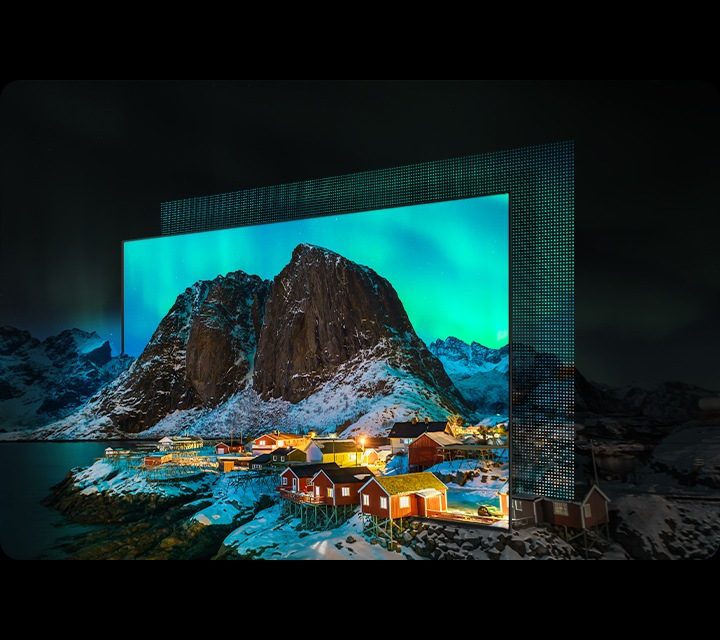
QD-OLED: Samsung's version of OLED
In an OLED, each pixel produces its own light and can switch off completely: perfect black, infinite contrast, no halo. The QD-OLED, made by Samsung Display, adds a layer of quantum dots (tiny crystals that convert blue light into very pure red and green). Result: more vivid and brighter colours, especially in bright tones, and an extreme viewing angle. In 2026, Samsung claims QD-OLEDs up to 35% brighter on the S95H and S99H; HelloTV measured around 2,700 nits on a small area of the S95H screen.
WOLED: Samsung's other OLED
Depending on the series and size, Samsung also uses panels WOLED, made by LG Display: the S92H in most sizes, the S85H, the S95H in 48 inches and the S99H in 83 inches. WOLED offers slightly deeper blacks in a lit room, QD-OLED more vivid colours. Both are excellent: don't lose sleep over this detail, but be aware that two sizes of the same series can have a slightly different picture.
Micro RGB: the big new arrival for 2026
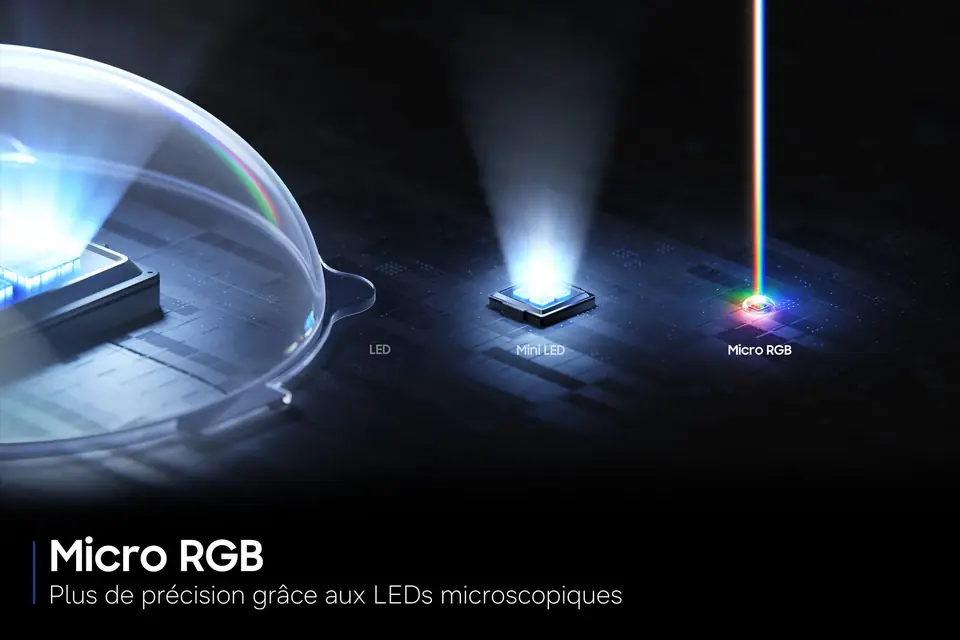
The Micro RGB is still an LCD screen, but its backlight is made of tiny LEDs in red, green and blue individually driven, instead of blue or white LEDs. Samsung claims 100% of the BT.2020 colour space, the benchmark for HDR cinema. Colours stay pure even at very high brightness, and there is no risk of burn-in. The limitation: like any LCD, a slight halo can appear around a bright object on a black background, and blacks don't match OLED's. Two series in 2026: R95H and R85H. Our article RGB Mini LED and Micro RGB compares the brands.
Don't confuse it with the MicroLED (The Wall), a self-emissive technology reserved for very large screens at five- or six-figure prices.
Neo QLED and Mini LED
Neo QLED is Samsung's name for quantum-dot Mini LED : thousands of tiny LEDs behind the screen, grouped into zones that switch on or off depending on the picture (‘local dimming'). The more zones there are, the better the contrast. Samsung calls its zone management Supreme Mini LED Dimming. The QN80H and QN70H series are Neo QLEDs; the M80H, M70H and M74H form a range Mini LED simpler and cheaper.
QLED (without 'Neo') denotes a quantum-dot LCD with standard LED lighting: this is the case of the classic The Frame. Crystal UHD is the entry-level 4K LED.
The processor and artificial intelligence
The processor is the TV's brain: it upscales images to 4K, reduces noise and handles motion. Samsung uses several in 2026:
- NQ4 AI Gen3 : OLED S99H, S95H, S92H and The Frame Pro.
- Micro RGB AI Engine Pro (R95H) and Micro RGB AI Engine (R85H): specially designed to drive the coloured LEDs.
- NQ4 AI Gen2 : S85H, QN80H, M80H and The Frame.
- NQ4 AI : QN70H. Mini LED Processor 4K : M70H and M74H. Crystal Processor 4K : Crystal UHD.
Around the processor, Samsung stacks features with marketing names: AI Upscaling Pro (upscaling of low-definition images), Color Booster Pro (colours adjusted to the scene), Real Depth Enhancer (depth effect), AI Mode (automatic picture and sound adjustment according to the programme) and AI Football Mode Pro (a dedicated football mode). Useful day to day, but for a film we often advise switching off the automatic effects: see our Samsung settings.
Vision AI Companion
It's the built-in assistant on Samsung's 2026 models. It brings together Bixby (Samsung's voice assistant), Microsoft Copilot and Perplexity. You can ask it a question about what you're watching, request a recommendation or practical information, by voice, from the remote.
HDR: HDR10+ yes, Dolby Vision no
HDR (High Dynamic Range) lets whites appear brighter and shows more nuance. Samsung supports the HDR10 (the basic format), the HLG (live TV) and its own dynamic format, the HDR10+, which adjusts the picture scene by scene. Adaptive versions (which take the room's lighting into account) and Gaming versions (for games) are available on recent models.
However, no Samsung supports Dolby Vision, nor the new Dolby Vision 2. Netflix or Disney+ films in Dolby Vision are then shown in HDR10. On a bright TV with a good processor, the difference is small for most people; a demanding cinephile may prefer another brand. More details in our article on HDR.
Glare Free: Samsung's anti-glare
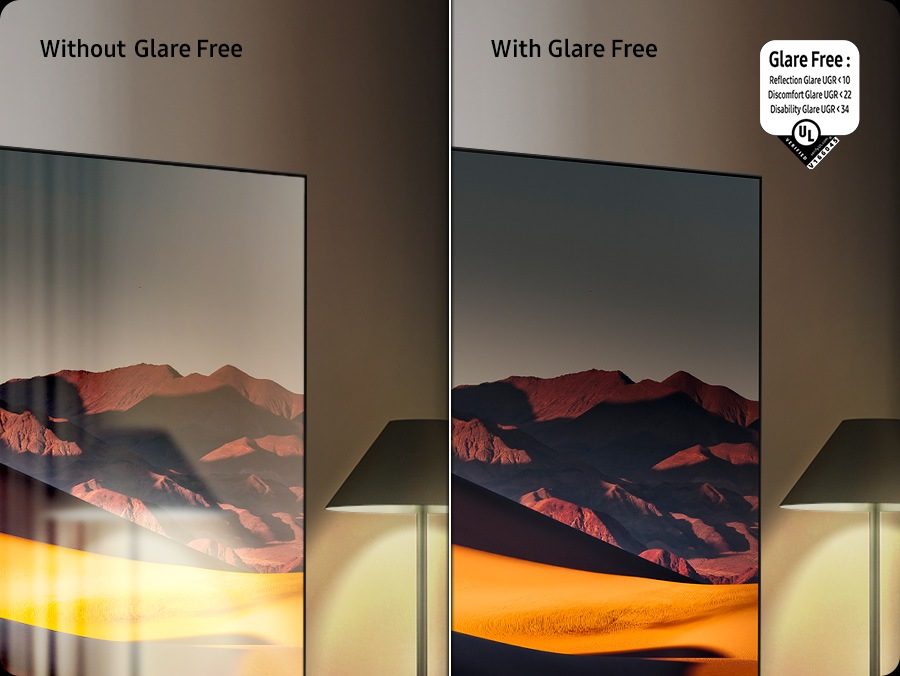
The Glare Free is a matt treatment of the screen surface. It scatters light from windows and lamps instead of reflecting it like a mirror. It's one of Samsung's strongest arguments for Belgian living rooms, which are often glazed. Unlike older matt screens, it doesn't create a visible grey haze in most rooms; in direct sunlight, blacks can look slightly less deep.
- With Glare Free : S99H (third generation), S95H, S92H, R95H.
- Matte screen : The Frame and The Frame Pro.
- Without Glare Free : S85H (simple anti-reflection filter), R85H, QN80H, QN70H, Mini LED and Crystal UHD.
Sound: OTS, Dolby Atmos and Q-Symphony
- OTS (Object Tracking Sound) : several speakers spread around the screen make the sound 'follow' the action. OTS+ on the S99H, S95H and R95H, OTS on the S92H, OTS Lite (simplified version) on the others.
- Dolby Atmos : three-dimensional sound, with height effects. Found on most models; the QN70H spec sheet does not mention it.
- Channels : 4.2.2 and 70 W on the S99H, S95H and R95H; 2.1.2 and 60 W on the S92H; 20 to 30 W in 2.0 elsewhere. The final '.2' refers to the upward-firing speakers.
- Adaptive Sound : the sound adapts to the room and the programme. Recent models can also boost voices to make dialogue easier to follow.
- Q-Symphony : with a compatible Samsung soundbar, the TV's speakers and the soundbar's speakers play together instead of cutting out.
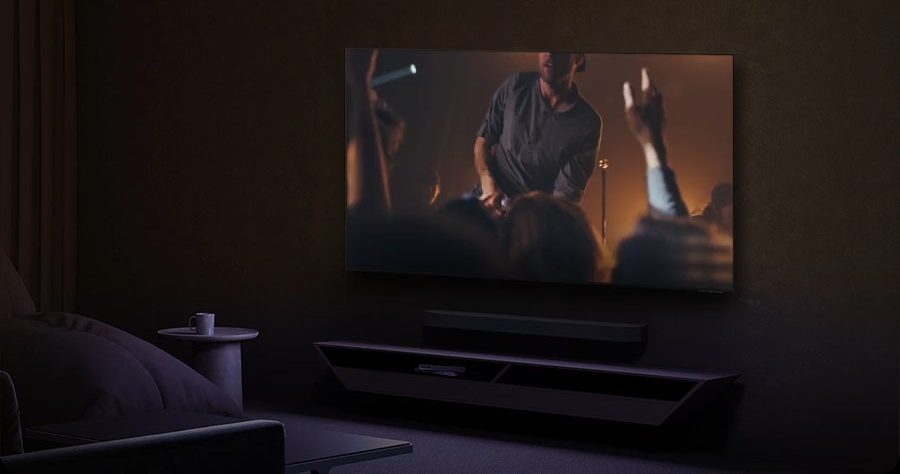
To choose a soundbar wisely, read our TV sound guide.
Gaming features
- Motion Xcelerator 144 Hz or 165 Hz : the maximum refresh rate in games, mainly useful on PC. PS5 and Xbox consoles go up to 120 Hz.
- HDMI 2.1 : four 4K high-refresh-rate HDMI ports on the OLED S99H, S95H, S92H and S85H, on the Micro RGB models and on the QN80H.
- VRR and FreeSync Premium Pro : the TV's refresh rate follows the game's, which eliminates screen tearing.
- ALLM : the TV switches to game mode automatically when the console starts.
- Game Bar : a quick in-game menu showing the refresh rate, VRR and settings.
- Gaming Hub : play without a console via the cloud (Xbox Cloud, GeForce Now…), with a subscription and a controller.
To find out everything about gaming, see our gaming TV guide.
Design and features unique to Samsung
- One Connect : a separate box that houses all the connections. A single slim cable runs to the screen. Included on the S95H from 55 to 77 inches and on The Frame 55-inch. Wireless One Connect (wireless) included on The Frame Pro, and optional on the S99H and R95H ('Wireless One Connect Ready').
- FloatLayer : the design of the S99H, whose screen appears to float in front of a metal frame.
- Art Mode and Art Store : the TV displays artworks when you're not watching it. Art Store is a paid subscription, available on The Frame and extended to the OLED S95H and S99H.
- Magnetic bezels : on The Frame, the frame can be swapped in a few seconds.
- SmartThings : the app that controls the TV and smart home from your phone.
- Samsung Knox : the security protection of the Tizen system.
If you only remember one Samsung technology, make it Glare Free. In a living room with large windows, it often matters more than nits or the processor. Come and compare it in store with a glossy screen: the difference is obvious.
These technologies in store
 OLED TV SAMSUNG TQ55S95H€1,763.00
 OLED TV SAMSUNG TQ55S99H€2,264.00
 LED TV SAMSUNG TMR65R95H€2,654.00
 TV LED SAMSUNG TMR65R85H€1,879.00
 OLED TV SAMSUNG TQ55S92H€1,416.00
 TV QLED SAMSUNG TQ65QN80H€961.00
 NEO QLED TV SAMSUNG TQ55LS03HW€1,454.00
The Samsung glossary, translated plainly
| Samsung name | What it means |
|---|---|
| QD-OLED | OLED with quantum dots, very bright colours |
| Micro RGB | LCD lit by red, green and blue LEDs |
| Neo QLED | quantum-dot Mini LED |
| QLED | Quantum dot LCD with standard LED backlighting |
| Crystal UHD | Entry-level 4K LED |
| Supreme Mini LED Dimming | Mini LED backlight zone management |
| NQ4 AI Gen3 / Gen2 | Picture processors, from newest to previous |
| Vision AI Companion | Assistant combining Bixby, Copilot and Perplexity |
| AI Upscaling Pro | Upscaling of low-definition images to 4K |
| Color Booster Pro | Automatic colour enhancement |
| Real Depth Enhancer | Depth effect on foreground elements |
| Glare Free | Matte anti-glare screen |
| HDR10+ Adaptive | Dynamic HDR that takes room lighting into account |
| Motion Xcelerator | High refresh rate for motion and gaming |
| OTS, OTS+, OTS Lite | Sound that follows the on-screen action, in three levels |
| Q-Symphony | Samsung TV and soundbar work together |
| One Connect | Separate box that houses all the ports |
| FloatLayer | 'Floating' design of the S99H |
| Gaming Hub | Cloud gaming without a console |
| Tizen / One UI Tizen | Samsung's Smart TV system |
| Samsung TV Plus | Built-in free channels |
Want to see which series combine these technologies? Everything is in our Samsung 2026 range page.
Frequently asked questions
QD-OLED or WOLED, which is best?
Both are excellent. Samsung's QD-OLED delivers more vivid colours and an extreme viewing angle. WOLED offers slightly deeper blacks in a lit room. At Samsung, the panel type depends on the series and the size.
Is Micro RGB the same as MicroLED?
No. Micro RGB is an LCD screen lit by tiny red, green and blue LEDs. MicroLED, like Samsung's The Wall, is a self-emissive technology that costs tens of thousands of euros.
Does Glare Free wash out the picture?
Very little. It is one of the best matte treatments on the market: it removes reflections from windows and lamps with no visible haze in most living rooms. In direct sunlight, blacks may look slightly less deep, as with any matte screen.
Does HDR10+ replace Dolby Vision?
It does the same job: it adjusts the picture scene by scene. Prime Video uses it. Netflix and Disney+ mainly use Dolby Vision, which then displays as HDR10 on a Samsung.
What is the One Connect box for?
It houses all the ports (HDMI, aerial, USB) in a separate box. A single slim cable runs to the screen, so the wall looks very tidy. It is included with the S95H (55 to 77 inches) and The Frame 55 inch, and available as an optional wireless kit for the S99H and R95H.
Which soundbar does Q-Symphony work with?
With compatible Samsung soundbars: the TV's speakers and the soundbar's speakers play together. Any other soundbar also works over HDMI eARC, but without this synergy.
Come and compare the screens in person
At our Temploux shop, we switch on TVs side by side with your content. Or ask our expert salesperson online, right now.
Read next
 TechnologyOLED explained simply (WOLED, QD-OLED, Tandem)Perfect blacks, infinite contrast, a picture that still looks great from the side: OLED is a dream. But how does it work, what's the difference between WOLED and QD-OLED, and what about the famous burn-in: myth or reality? We tell you everything.3 min read
 TechnologyRGB Mini LED, Micro RGB, True RGB: the big new thing for 2026It's THE trend of the year: all the major brands are launching TVs with RGB backlighting. Samsung talks about Micro RGB, Sony about True RGB, and Hisense and TCL about RGB Mini LED. Behind the names is a simple idea that delivers spectacular colours.2 min read
 TechnologyLED, QLED, Mini LED: LCD screens explainedQLED, Neo QLED, QNED, Mini LED, SQD… all these names belong to one family: the LCD screen. What makes the difference is how it's lit. We explain everything so you can read a spec sheet like a salesperson.2 min read